
For students, companies and professionals, all over the world.
Remoters puts you in touch with a home finder living there, who speaks your language, searches to your criteria, views on your behalf and stays with you through to the signed lease.
They know the neighbourhoods, the rents and how the local market works, and they speak your language.
Listings, agencies, local network: they shortlist to your criteria and view properties on your behalf.
They present your application to the landlord and negotiate the lease terms for you.
Verified home, lease reviewed, secure payment: you sign knowing exactly what you are getting.
Six missions, from the first brief to key handover.

Real budget, viable neighbourhoods, size, life constraints. The brief is written before the first listing — that's what saves three months of pointless viewings.
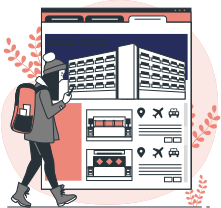
Portals, local agencies, private landlords: your home finder checks every new listing daily and contacts agencies on your behalf, so nothing slips through.
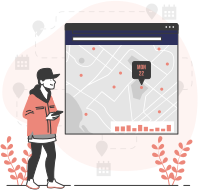
Filmed viewings, an honest report, walks through the neighbourhood at different hours. You no longer need to travel: your home finder does it all for you remotely.

Local rent levels, service charges, the state of the property, lease length. Concrete arguments to negotiate the terms — on your side, this time.

Locally required documents, guarantor, translation, review of the lease and the inventory. This is where foreign applications most often fall apart.

Inventory, key handover, utilities set-up, first admin steps. Your home finder doesn't disappear once the contract is signed: they remain a valuable contact for any questions about life on the ground.
No scams, verified homes, secure payment.
A home found in a few weeks.
Guided by a local home finder, in your language.
Everything handled remotely, stress-free.
Four steps, from your request to the signed lease.
You start by filling in a short questionnaire to tell us a bit more about your search.
One of our home finders then takes over and contacts you for a free first conversation. The goal? Understanding exactly what you need.
If it clicks and you want to move forward, you receive a tailored quote. Once approved, the search begins!
Your home finder searches for you, shares their finds, stays with you through to signing the lease — all that’s left is packing your bags.
Join a community of happy clients.
Philadelphia in brief for long-term renters:
Philadelphia is a compelling destination for long-term renters seeking a major US city with a lower cost of living than New York or Boston. The city combines a rich historical heritage — home to Independence Hall and the Liberty Bell — with a vibrant contemporary culture, a thriving food scene, and a strong arts community.
Philadelphia is the economic hub of Pennsylvania and hosts the headquarters of hundreds of corporations, offering strong employment opportunities across healthcare, education, and technology sectors (source: Expat Arrivals; BR Moving, 2025). Major employers include the University of Pennsylvania Health System, Jefferson Health, and Comcast, among others.
The city is served by SEPTA (Southeastern Pennsylvania Transportation Authority), which operates buses, trolleys, subway lines, and regional rail, making car-free living entirely feasible in many neighborhoods. Philadelphia is also recognized as one of the most walkable and bike-friendly cities in the United States (source: Expat Arrivals). Residents benefit from world-class museums such as the Philadelphia Museum of Art and the Penn Museum, as well as a dense network of parks, including Fairmount Park, one of the largest urban park systems in the country.
Living in Philadelphia on a day-to-day basis is generally practical and affordable compared to other major US East Coast cities. Here is what to expect once you have signed your lease:
Philadelphia's rental market is one of the most active on the US East Coast, driven by a large student and professional population anchored by institutions such as the University of Pennsylvania, Drexel University, and major hospital networks. As of August 2025, the average rent in Philadelphia stands at approximately 1,751 USD/month for a one-bedroom apartment, which is about 7% above the national average of 1,637 USD/month (source: Apartments.com, August 2025).
The overall vacancy rate in the city hovers between 5% and 7%, with downtown occupancy reaching approximately 95.5% (source: propertymanagersphiladelphia.com, 2025). This indicates a competitive market with strong demand, particularly in central and well-connected neighborhoods. New construction activity slowed after a surge in 2024, which is expected to keep upward pressure on rents, with a projected increase of around 3% by end of 2025 (source: propertymanagersphiladelphia.com, 2025).
Demand is especially strong in neighborhoods such as Fishtown, Northern Liberties, and Graduate Hospital, which are seeing consistent rental interest from young professionals and remote workers (source: issmanagement2000.com, December 2025). Meanwhile, more affordable pockets in Northeast Philadelphia and Southwest Philadelphia continue to attract budget-conscious renters.
Philadelphia is a city of distinct neighborhoods, each with its own character, rental price range, and lifestyle appeal. Here is an overview of the most relevant areas for long-term renters:
Philadelphia offers a wide rental budget spectrum, making it accessible to a variety of tenant profiles. As of mid-2025, median rents in the city range from approximately 1,680 to 1,721 USD/month across all unit types (source: propertymanagersphiladelphia.com, 2025). Renters on a tighter budget can find viable options in neighborhoods such as Hartranft or Fern Rock, while those seeking more central or trendy locations — such as Fishtown, Northern Liberties, or Center City — should budget upward of 1,700–2,200 USD/month for a one-bedroom unit.
It is increasingly difficult to find apartments under 1,000 USD/month in neighborhoods close to Center City or major transit routes (source: Bay Management Group, 2024). Overall, rents are expected to rise by approximately 3% by end of 2025 (source: propertymanagersphiladelphia.com, 2025), so locking in a lease early in your search is advisable.
Rental prices in Philadelphia vary significantly depending on the neighborhood, apartment size, and building amenities. According to RentCafe (June 2026), the average rent for an apartment in Philadelphia stands at approximately 2,022 USD/month. Studios typically start around 1,380–1,492 USD/month, one-bedroom apartments average 1,545–1,751 USD/month, and two-bedroom units range from 1,745 to 2,203 USD/month. Three-bedroom rentals can reach 3,086 USD/month or more, particularly in sought-after areas such as Rittenhouse Square or Center City.
More affordable options remain available in neighborhoods like Hartranft, where one-bedroom apartments can be found for around 705 USD/month, or Southwest Philadelphia, where average one-bedroom rents hover near 1,025 USD/month (source: Rent.com, 2024). In contrast, premium neighborhoods such as Rittenhouse Square and University City command one-bedroom rents of approximately 2,200–2,386 USD/month (source: Ark7, 2025).
When searching for a long-term rental in Philadelphia, several common mistakes can slow down your search or cost you money:
Here are key tips to help you secure a long-term rental in Philadelphia efficiently:
Finding the right long-term rental in Philadelphia can be time-consuming, especially when navigating a competitive market with a vacancy rate of just 5–7% (source: propertymanagersphiladelphia.com, 2025). Remoters offers a rental search support service to help you identify suitable apartments, prepare a strong rental application, and coordinate viewings — whether you are relocating from another US city or moving from abroad.
The service covers key steps such as defining your search criteria by neighborhood and budget, shortlisting listings that match your needs, and guiding you through the application and lease-signing process. This is particularly valuable for international renters or remote workers who may not be familiar with Philadelphia's neighborhoods or Pennsylvania's tenant regulations.
Prepare photo ID, proof of income (payslips, employment contract or bank statements), references from previous landlords and, if possible, an employer's letter. Your credit score is usually checked: a score above 650 is often required.
Have everything ready before viewing: good flats often go the day they are listed. Since December 2025, application fees have been capped at USD 50 per application.
Yes: some landlords accept virtual viewings for remote applicants. Before signing, check that the landlord holds a rental licence from the Department of Licenses and Inspections (L&I), which you can look up on the city's official website.
A Remoters home finder based in Philadelphia, who speaks your language, can view for you with photos or video, give you detailed feedback and, depending on the quote, review the lease: pets, subletting, early termination penalties.
Center City and Rittenhouse Square start at USD 2,500/month. Fishtown, a trendy area, is around USD 2,276/month and Northern Liberties USD 2,412/month; University City reaches about USD 3,255/month.
For less, South Philadelphia, a working-class area, and Manayunk, by the river (about USD 2,189/month), are more affordable; Chestnut Hill, residential and quiet, is around USD 1,963/month. Visit before choosing: the feel changes a lot from one neighbourhood to the next.
Pennsylvania law caps the deposit at two months' rent in the first year, then one month in later years; above one month, the landlord must accept payment in instalments. Application fees have been capped at USD 50 since December 2025.
Also budget for utilities, rarely included: water, electricity, gas and internet add USD 150 to 300/month depending on the size of the home. Document the move-in inventory to get your deposit back.