

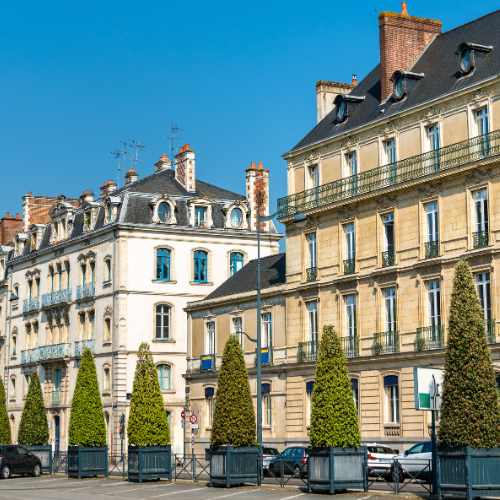



Buying property à Berlin with a dedicated expert

Drapeau du Royaume-Uni avec des bandes rouges, blanches et bleues en forme de croix et de diagonales.
An English-speaking Home Finder who lives there
Emoji de détective avec chapeau, loupe et cheveux gris.
Sees the good places before they hit the market
Médaille d'or avec un ruban rouge indiquant la première place.
Fights for your offer, not the seller's
Symbole dollar vert sur fond blanc.
The real local price, not the foreigner tax

What kind of property are you looking for à Berlin ?

Describe your project, one of our real estate hunters will look for the ideal property for you

Why work with a property hunter?

Time spent by the buyer
Symbole d'information en cercle bleu foncé sur fond transparent.
When you search alone, about 85% of the time is spent on research, and 15% on visits. With a hunter, you only do the visits
Icône de fermeture (croix)
Access to the off-market
Purchase price
Virtual pre-visits
Secure formalities
Symbole d'information en cercle bleu foncé sur fond transparent.
Customer satisfaction
Only 20% of satisfied buyers according to the 2018 Crédit Foncier study. For its part, Remoters gets a score of 4/5 or 5/5 in 95% of cases
Icône de fermeture (croix)

Buying alone abroad

140 hours
Icône rouge de croix X sur fond blanc.
Very difficult negotiation
Icône rouge de croix X sur fond blanc.
20%

Buying  with Remoters

20:00
14% discount obtained on average
95%
Photo of Aude, home finder in Berlin

Aude , or another expert property hunter based à Berlin , will personally manage your search.

Guide local de l’achat immobilier

Acheter un bien immobilier

Buying property in Berlin in under 30 seconds:

  1. No restrictions for foreigners — any individual or legal entity may purchase property in Berlin regardless of nationality or residency status.
  2. Budget for 12%–15% on top of the purchase price in mandatory acquisition costs: 6% transfer tax (Grunderwerbsteuer), ~2% notary and land registry fees, and up to 3.57% agent commission (buyer's share).
  3. Average purchase price for existing apartments: €5,130 EUR/m² city-wide in 2025; new builds average €8,200 EUR/m².
  4. The notary is central — all purchase contracts must be signed before a notary to be legally valid. The buyer typically selects the notary.
  5. Non-residents can get a mortgage but should expect a 20%–40% down payment and LTV ratios of 60%–80%.
  6. The full process from signed contract to land registry transfer takes approximately two to three months.
  7. Hold for 10 years and any capital gain on resale is fully exempt from tax.

Prix par type de bien

Fourchettes de prix selon la surface, la typologie et l’usage du logement.

Purchase prices in Berlin vary significantly by property type. The following figures reflect 2025 market data (source: Guthmann Estate Market Report 2025 and CBRE/Berlin Hyp Housing Market Report 2025):

  • Existing apartments (Bestandswohnungen): average transaction price of €5,130 EUR/m² city-wide in 2025 (+3% year-on-year), with an average apartment transaction price of approximately €372,100 EUR (approx. 72 m²). Asking prices stand at €5,810 EUR/m² or €522,800 EUR per apartment on average.
  • New-build apartments (Neubauwohnungen): average asking price of €8,200 EUR/m² in Q1 2025 (+3% year-on-year). New builds command a significant premium over existing stock, reflecting higher construction and energy standards.
  • Apartment buildings (Mehrfamilienhäuser): asking prices fell 4.4% to a median of €3,041 EUR/m² in 2024 (source: CBRE/Berlin Hyp, 2025). Transaction volume for apartment buildings stood at approximately €1.5 billion EUR in Q1–Q3 2025, with around 580 buildings projected to be sold in full-year 2025.
  • Single-family houses and townhouses: prices vary widely by location and condition; central and south-western districts (Charlottenburg, Zehlendorf, Dahlem) command the highest prices for houses, typically well above the apartment average per m².

Demand is most concentrated on properties priced below €400,000 EUR, which represent the broadest segment of the Berlin purchase market (source: Guthmann Estate Market Report 2025).

Prix et profils des quartiers

Les secteurs à comparer selon le budget, le mode de vie et le projet d’achat.

Berlin's 12 boroughs offer very different purchase price levels and buyer profiles. The following figures are based on notarised transaction prices for existing apartments in 2025 (source: Guthmann Estate Market Report 2025):

  • Mitte: €6,030 EUR/m² (+3.0% in 2025) — Berlin's most expensive district. Attracts international buyers, investors, and professionals seeking central urban living. High demand, limited supply of vacant properties.
  • Friedrichshain-Kreuzberg: €5,810 EUR/m² (+1.0% in 2025) — popular with younger buyers, creatives, and international residents. Vibrant neighbourhood character; prices 10%–20% below Mitte depending on micro-location (source: First Citiz Berlin).
  • Charlottenburg-Wilmersdorf: €5,630 EUR/m² (+1.0% in 2025) — established, residential western district. Attracts families and buyers seeking a more traditional urban environment. Prices approximately 10% below Mitte.
  • Prenzlauer Berg (within Pankow borough): among the most sought-after areas for international buyers; premium micro-locations around Kollwitzplatz and Kastanienallee reach €7,000 EUR/m² and above (source: First Citiz Berlin).
  • Neukölln: €4,620 EUR/m² (–1.0% in 2025) — more affordable entry point; popular with first-time buyers and investors. Currently in a mild correction phase.
  • Steglitz-Zehlendorf: €4,580 EUR/m² (–2.0% in 2025) — southern residential district, family-oriented, with green surroundings.
  • Marzahn-Hellersdorf: €3,180 EUR/m² (–5.0% in 2025) — most affordable borough; located in former East Berlin; highest price correction in 2025.

New-build prices across Berlin averaged €8,200 EUR/m² in early 2025, up 3% year-on-year, with significant premiums in central locations (source: Guthmann Estate, 2025).

Évolution du marché immobilier

Dynamique des prix, niveau de demande et biens les plus recherchés.

Berlin's residential property purchase market has gone through three distinct phases over the past decade:

2015–2022 — sustained growth: Berlin experienced one of Europe's most dynamic real estate cycles, with average annual price increases of approximately 8% per year, driven by strong population growth, a persistent housing shortage, and historically low interest rates (source: Guthmann Estate, 2025).

2022–2024 — correction: the ECB's rapid rate increases from mid-2022 sharply dampened buyer demand. Transaction prices for existing apartments fell approximately 4% in 2023 and a further 3% in 2024 (source: Guthmann Estate Market Report 2025). Asking prices for condominiums decreased by 0.9% to €5,696 EUR/m² in 2024, while apartment building asking prices fell 4.4% to €3,041 EUR/m² (source: CBRE / Berlin Hyp Housing Market Report 2025).

2025 — stabilisation and recovery: after two years of declines, transaction prices for existing apartments rose 3% in 2025 to an average of €5,130 EUR/m², with an average apartment transaction price of approximately €372,100 EUR. Asking prices stand at €5,810 EUR/m² (source: Guthmann Estate Market Report 2025). Approximately 11,300 apartments were notarised in 2025, in line with 2024 volumes. Demand is concentrated on properties priced below €400,000 EUR. New-build prices averaged €8,200 EUR/m² in early 2025, up 3% year-on-year (source: Guthmann Estate, 2025).

The structural drivers underpinning Berlin's market remain intact: a housing vacancy rate below 2%, continued population growth, and a chronic undersupply of new construction relative to demand.

Budget total et fiscalité

Prix d’acquisition, taxes, honoraires et dépenses à prévoir en complément.

When purchasing property in Berlin, buyers must budget for the purchase price plus a set of mandatory acquisition costs that typically add 12% to 15% on top of the agreed price.

  • Grunderwerbsteuer (property transfer tax): 6% of the purchase price in Berlin — one of the highest rates in Germany (source: Berlin official tax portal, 2024). On a €400,000 EUR purchase, this amounts to €24,000 EUR.
  • Notary fees: approximately 1.5% to 2% of the purchase price, mandatory under German law (GNotKG) for contract certification and land registry registration.
  • Land registry (Grundbuch) entry: approximately 0.5% of the purchase price.
  • Estate agent commission (Maklerprovision): where applicable, split equally between buyer and seller since December 2020; the total commission ranges from 3% to 7.14% including 19% VAT, meaning the buyer's share is typically 1.5% to 3.57% (source: German Civil Code §656c).

On a €500,000 EUR property, total transaction costs for the buyer can therefore reach approximately €50,000–€75,000 EUR (source: Berlin Real Estate Investment Guide, Sweet Home, 2024).

Capital gains tax (Spekulationssteuer): if you resell the property within 10 years of purchase, any profit is taxed at your personal income tax rate. After 10 years of ownership, the sale is fully exempt from capital gains tax. If the property was used as your primary residence for at least the year of sale and the two preceding years, the exemption applies immediately regardless of the holding period (source: Settle in Berlin, 2024).

Étapes de l’acquisition

Le déroulement du projet depuis la définition des critères jusqu’à la remise des clés.

Buying property in Berlin follows a structured legal process governed by German civil law. The key steps are:

  1. Property search and market analysis: identify target districts, set a budget including all acquisition costs, and shortlist properties via portals or agents.
  2. Viewing and due diligence: visit the property, review the Grundbuch extract, energy certificate, building documentation, and — for apartments — the Teilungserklärung and owners' association accounts.
  3. Price negotiation and offer: submit a written offer; verbal agreements are not legally binding in Germany. Agree on the purchase price, payment schedule, and handover date.
  4. Financing confirmation: obtain a binding mortgage offer from your bank before proceeding to the notary.
  5. Notary appointment (Beurkundung): the buyer typically selects and commissions the notary. The notary drafts the Kaufvertrag (purchase contract), sends it to all parties at least 14 days before signing, and reads it aloud at the appointment. Both buyer and seller sign in the notary's presence — this step is mandatory under German law for the contract to be valid.
  6. Auflassungsvormerkung (priority notice): the notary immediately registers a priority notice in the Grundbuch to protect the buyer's claim while the transfer is being processed.
  7. Payment of Grunderwerbsteuer: the tax office issues an assessment; the buyer pays the 6% transfer tax before ownership can be transferred.
  8. Purchase price payment: once the notary confirms all conditions are met, the buyer transfers the purchase price to the seller (or via a notary escrow account).
  9. Land registry transfer (Eigentumsumschreibung): the notary submits the transfer request to the Grundbuch. Full registration of the new owner typically takes two to three months after the notary appointment (source: Savills Germany, 2024).
  10. Handover of keys: physical possession is transferred on the agreed date, usually upon receipt of the full purchase price.

Documents nécessaires

Les justificatifs à préparer pour acheter et financer un bien en Italie.

To complete a property purchase in Berlin, buyers must provide the following documents to the notary, the bank (if financing), and the land registry:

  • Valid passport or national ID card (original required at the notary appointment).
  • German tax identification number (Steuer-Identifikationsnummer) — or proof of application if not yet received; required for tax registration purposes.
  • Proof of financing: mortgage approval letter from a bank, or bank statements demonstrating sufficient funds (anti-money-laundering compliance).
  • Marriage certificate (if purchasing jointly with a spouse).
  • Power of attorney (notarised) if you cannot attend the notary appointment in person.
  • Proof of address — foreign documents may require an apostille or certified translation into German.
  • Property-related documents provided by the seller or agent: current Grundbuch extract (land register), energy performance certificate (Energieausweis), building permits, floor plans, and — for condominiums — the Teilungserklärung (declaration of division) and minutes of recent owners' association meetings.

Foreign buyers should allow extra time for document authentication: depending on the country of origin, documents may require an apostille or full legalisation through the German diplomatic mission (source: Guthmann Estate, 2024).

Vérifications juridiques et techniques

Contrôles du titre, du cadastre, de la conformité et de l’état réel du bien.

Before signing a purchase contract in Berlin, buyers should carry out thorough legal and technical due diligence. Key checks include:

  • Grundbuch (land register) extract: the most critical document. Verify: (i) that the seller is the registered owner (Abteilung I); (ii) any charges, easements, usufruct rights, rights of residence (Wohnrecht), or pre-emption rights (Abteilung II); (iii) any mortgages or land charges (Grundschulden) registered against the property (Abteilung III). Unusual entries must be explained and, where possible, cleared before completion (source: Your Place Berlin / Finance for Expats, 2024).
  • Municipal pre-emption right (Vorkaufsrecht): the Berlin municipality may exercise a pre-emption right within three months of a notarised sale. Verify whether the property is located in a designated area subject to this right.
  • For condominiums — Teilungserklärung and Aufteilungsplan: the declaration of division defines each owner's share of the building and the allocation of common areas. Review the owners' association (WEG) minutes, maintenance reserve fund (Instandhaltungsrücklage) balance, and any pending special assessments.
  • Energy performance certificate (Energieausweis): legally required to be provided by the seller. Review the energy rating, as it affects both running costs and future renovation obligations under German energy efficiency regulations.
  • Building permits and planning documentation: confirm that all construction, extensions, and conversions have valid permits. Unpermitted works can create significant legal and financial liability for the buyer.
  • Technical inspection: for older buildings, commission an independent structural survey to assess the condition of the roof, façade, heating system, plumbing, and electrical installations. This is not legally required but is strongly recommended.
  • Encumbrances and tenancies: check whether the property is sold vacant or occupied, as this affects both the purchase price and the timeline for taking possession.

Financement des non-résidents

Apport, crédit, justificatifs et contraintes propres aux acquéreurs étrangers.

There is no legal restriction preventing non-residents or foreign nationals from purchasing property in Berlin or accessing German mortgage financing. However, banks apply stricter criteria to non-resident applicants than to German residents.

  • Loan-to-value (LTV) ratios: non-residents are typically offered LTV ratios of 60% to 80%, compared to up to 100% financing potentially available to German residents with strong local profiles. EU citizens may access LTV ratios closer to 80%, while non-EU nationals often face caps around 60% to 70% (source: Investropa, September 2025).
  • Down payment: non-residents should expect to provide a deposit of 20% to 40% of the purchase price, plus all acquisition costs (transfer tax, notary, land registry), which must be funded from equity.
  • Interest rates: as of 2025, fixed-rate mortgage rates in Germany range from approximately 3.5% to 5% depending on the term and borrower profile; non-residents may be quoted rates at the higher end of this range (source: Mono Estate News, 2025).
  • Required documentation for mortgage application: valid passport, proof of income (payslips or tax returns — foreign documents may require certified translation and apostille), bank statements, German IBAN account, and proof of address. Anti-money-laundering checks may extend processing timelines.
  • German tax ID: not required to purchase property, but necessary if the property is subsequently rented out or if ongoing German tax obligations arise.
  • Specialist brokers: international mortgage brokers with experience in the German market can help non-residents navigate lender requirements and compare offers across multiple institutions.

Investissement et potentiel locatif

Demande locative, loyers, rendement indicatif et règles à anticiper.

Berlin is one of Germany's most active markets for buy-to-let property investment, supported by structural housing undersupply and strong occupancy rates.

  • Gross rental yields: Berlin's average gross rental yield stood at approximately 4.76% across the city as of Q1 2025, with significant variation by district (source: Investropa, Q1 2025). A separate analysis placed the Germany-wide average at 3.42% in Q1 2026 (source: Investropa, Q1 2026), reflecting Berlin's relative attractiveness.
  • District variation: outer districts where purchase prices remain lower tend to offer higher gross yields. Central districts such as Mitte and Charlottenburg offer lower yields (typically 3%–5%) but greater price stability and long-term capital appreciation potential (source: Berlin Real Estate 2025 analysis).
  • Occupancy rate: Berlin's residential vacancy rate was below 2% in 2025, with an occupancy rate exceeding 98% — one of the tightest markets in Germany (source: First Citiz Berlin, 2025).
  • Demand concentration: properties priced below €400,000 EUR attract the broadest pool of buyers and investors (source: Guthmann Estate Market Report 2025).
  • Regulatory environment: Berlin has active rent control legislation (Mietspiegel) and tenant protection rules that investors must factor into yield projections. Legal advice is strongly recommended before acquiring a tenanted property.
  • Capital gains: properties held for more than 10 years are fully exempt from capital gains tax on resale, making Berlin an attractive long-term hold market (source: Settle in Berlin, 2024).

Méthode de négociation

Analyse du juste prix et arguments employés pour défendre l’offre d’achat.

Negotiating a property purchase price in Berlin requires a data-driven approach and an understanding of the current market dynamics.

  • Understand the seller's motivation: the most important factor in gauging negotiation room is the seller's reason for selling — a motivated seller (relocation, financial pressure, estate sale) will typically accept a larger discount than one testing the market.
  • Benchmark against transaction prices: asking prices on portals are not transaction prices. In 2025, the Berlin-wide average asking price was €5,810 EUR/m² versus a transaction price of €5,130 EUR/m² — a gap of approximately 12% (source: Guthmann Estate Market Report 2025). Use notarised transaction data, not portal listings, as your reference.
  • Leverage property condition: properties with defects, outdated energy ratings, or deferred maintenance justify price reductions. The Berlin market in 2024 saw sharper price corrections in the lower segment precisely because defect-related reductions were enforced in negotiations (source: Berlin Hyp Housing Market Report 2025).
  • Check for pre-emption rights: order a Grundbuch extract (approximately €12 EUR via the official portal) to verify whether any third party holds a pre-emption right (Vorkaufsrecht). Berlin municipalities may exercise a municipal pre-emption right within three months of a sale.
  • Make a written offer: verbal agreements are not legally binding in Germany. Submit your offer in writing with a clear price, proposed payment schedule, and any conditions (e.g., subject to financing confirmation).
  • Include protective clauses: consider negotiating a financing condition clause in the purchase contract, allowing withdrawal or price adjustment if mortgage approval is delayed.
  • Act decisively on well-priced properties: demand for properties below €400,000 EUR remains strong; competitive properties in central districts attract multiple offers and leave limited room for negotiation.

Honoraires et contenu de la prestation

Mode de rémunération, services inclus et éventuels frais complémentaires.

When buying property in Berlin through a real estate agent, the following fee structure applies:

  • Agent commission (Maklerprovision): since December 2020, German law (§656c BGB) requires the commission to be split equally between buyer and seller when the agent was commissioned by the seller. The total commission typically ranges from 5.95% to 7.14% of the purchase price including 19% VAT, meaning the buyer's share is generally 2.975% to 3.57% of the purchase price (source: German Civil Code §656c; Guthmann Estate, 2024). If the agent waives the fee for one party, they cannot charge the other.
  • What the agent's service covers: property sourcing and shortlisting, organisation of viewings, market valuation and price benchmarking, negotiation support, coordination with the notary, and assistance with document collection.
  • Notary fees: approximately 1.5% to 2% of the purchase price, covering contract drafting, the notarisation appointment, registration of the priority notice (Auflassungsvormerkung), and submission of the ownership transfer to the land registry. The notary acts as a neutral party and does not represent either buyer or seller.
  • Independent legal review: not mandatory but recommended, particularly for foreign buyers or complex transactions. Fees vary by lawyer and scope of work.
  • Certified translation: required if any documents are in a language other than German; costs vary by document volume and language pair.

All fees are subject to 19% German VAT where applicable.

Préparez votre achat immobilier

Décrivez votre projet, votre budget et vos critères. Un chasseur local peut rechercher les biens, organiser les visites, vérifier les informations et vous accompagner pendant la négociation.

Décrire mon projet

How does it work?

1

Your home finder researches the ideal property based on your criteria.

2
They conduct property viewings, some on your behalf, others with you in person or remotely.
3
They negotiate the price and terms on your behalf. The hunter is still at 100% on the buyer's side.
4
They assist you until all documents are signed
5
It accompanies you until the signature of all documents, to avoid pitfalls.
Couple allongé sur le lit, pieds contre la tête de lit, s'enlaçant et regardant l'un l'autre.

Our hunters around the world!

Remoters continues to grow!
We are recruiting new hunters, do not hesitate to apply.
Carte du monde en trois panneaux avec des marqueurs rouges indiquant des emplacements en Amériques, Europe, Afrique et Asie.I am applying

FAQ

Une main portant un bracelet noir pointe sur l'écran d'un ordinateur portable tandis qu'une autre main tape.

Why choose an English-speaking home finder à Berlin ?

Searching for a property abroad requires time, organization, and a good understanding of local regulations, which may differ from those in France (notaries, land registry, taxation, etc.). A property hunter helps simplify the process by managing the search, selecting relevant properties, organizing viewings, and reviewing legal documents.

They work closely with the buyer to define clear criteria, identify suitable opportunities, and negotiate the best possible price. They may attend property visits on the buyer’s behalf or accompany them during a stay in Istanbul.

Thanks to their local network, the home finder also facilitates the legal and logistical steps of the purchase. From the initial search to the final signature, they provide tailored support and help ensure a smooth and secure buying experience.

Une personne porte une chemise à carreaux et utilise une calculatrice bleue sur un bureau en bois.
How much does the Remoters home finder service cost?

Remoters works with home finders around the world. Since real estate prices vary greatly depending on the location, it is difficult to apply a single pricing structure.

Each home finder sets their own fees based on the complexity of the project and the local market. You can contact them directly to learn more about their terms and evaluate the value they can bring to your purchase.

In many cases, the home finder’s fee is largely offset by negotiating a better purchase price and helping reduce legal and administrative risks.

Main tenant holding keys with house-shaped keychain near a door lock.
Will I have access to all the offers on the market?

There are three main types of property listings on the real estate market:

  • Agency listings
  • Private listings (from individual sellers)
  • “Off-market” opportunities, meaning properties that are not yet publicly advertised

When searching on your own, you will usually access the first two categories, provided you are familiar with the main listing platforms and able to identify outdated or misleading ads sometimes used to attract buyers.

Property hunters can provide access to all three types of opportunities. They screen listings before presenting them and leverage their network to identify relevant off-market properties.

Off-market does not mean properties remain hidden indefinitely. Rather, it refers to opportunities shared before public release, allowing buyers to position themselves early. Thanks to their professional network, a property hunter can help increase access to these early opportunities.

Cuisine moderne avec évier double, robinet chromé, cuisinière à gaz et décorations vertes et citrons jaunes.
Home finder vs real estate agent

When searching for a property abroad, your need is typically a home finder🕵️

A real estate agent represents the seller through a sales mandate and aims to market properties to potential buyers.

A home finder, on the other hand, represents the buyer through a search mandate. They do not have properties to sell. Instead, they search for a specific property based on the buyer’s criteria, sourcing opportunities from both private sellers and agencies.

While the real estate agent advises and supports the seller throughout the transaction, the home finder advises and assists the buyer at every step of the purchasing process, always acting in the buyer’s best interest.

Un homme en costume tenant une petite maison colorée dans sa main devant une calculatrice.
How do you choose the right home finder?

The right home finder is the one who helps you purchase a property that best matches your needs and criteria, at an optimized price.

Their fees should remain reasonable and create real value for your project. In many cases, the cost of the service is largely offset by stronger negotiation outcomes and better purchase conditions 🤑

When buying abroad, working with a French-speaking property hunter who is well established in the local market can be particularly beneficial. This helps reduce misunderstandings and increases your chances of accessing high-quality opportunities through their local network.

Deux mains d'hommes serrées en signe de poignée de main, fond beige neutre.

Interested in becoming a home finder for Remoters à Berlin ?

You should have:

🧙 Strong experience in the local real estate market
🌐 A solid network to access a wide range of property opportunities
⚖️ In-depth knowledge of local regulations
💸 Excellent negotiation skills
🛎️ Above all, a genuine desire to support clients in their property purchase projects

If this sounds like you, we encourage you to apply — we would be happy to welcome you to our network.

Button TextButton Text