
I describe my searchGet started
The #1 international network of home finders

Find your place in Reikjavik with a local home finder

For students, companies and professionals, all over the world.

Remoters puts you in touch with a home finder living there, who speaks your language, searches to your criteria, views on your behalf and stays with you through to the signed lease.

Your home finder, on site
An English-speaking home finder, based on site

They know the neighbourhoods, the rents and how the local market works, and they speak your language.

Shortlists properties and visits them for you

Listings, agencies, local network: they shortlist to your criteria and view properties on your behalf.

Backs your application and negotiates the lease

They present your application to the landlord and negotiate the lease terms for you.

Every step protected, no hidden surprises

Verified home, lease reviewed, secure payment: you sign knowing exactly what you are getting.

5,000+ clients supported
★★★★★ 4.8/5 on Google, 1,100+ reviews
220+ cities
60+ countries

What does a home finder actually do?

Six missions, from the first brief to key handover.

Illustration: scoping the search

They scope your search

Real budget, viable neighbourhoods, size, life constraints. The brief is written before the first listing — that's what saves three months of pointless viewings.

Illustration: local market specialist

They comb the whole market

Portals, local agencies, private landlords: your home finder checks every new listing daily and contacts agencies on your behalf, so nothing slips through.
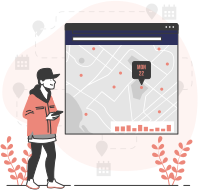
Illustration: viewings and neighbourhoods

They visit for you

Filmed viewings, an honest report, walks through the neighbourhood at different hours. You no longer need to travel: your home finder does it all for you remotely.

Illustration: price negotiation

They assess and negotiate

Local rent levels, service charges, the state of the property, lease length. Concrete arguments to negotiate the terms — on your side, this time.

Illustration: securing the application

They secure the application

Locally required documents, guarantor, translation, review of the lease and the inventory. This is where foreign applications most often fall apart.

Illustration: saving time when settling in

They stay with you until you're settled in

Inventory, key handover, utilities set-up, first admin steps. Your home finder doesn't disappear once the contract is signed: they remain a valuable contact for any questions about life on the ground.

What you get

Safety

No scams, verified homes, secure payment.

Speed

A home found in a few weeks.

Human

Guided by a local home finder, in your language.

Peace of mind

Everything handled remotely, stress-free.

How it works

Four steps, from your request to the signed lease.

1

We get acquainted

You start by filling in a short questionnaire to tell us a bit more about your search.

2

Free first call

One of our home finders then takes over and contacts you for a free first conversation. The goal? Understanding exactly what you need.

3

The adventure begins

If it clicks and you want to move forward, you receive a tailored quote. Once approved, the search begins!

4

Heading to your new home

Your home finder searches for you, shares their finds, stays with you through to signing the lease — all that’s left is packing your bags.

+5000
clients supported since 2023
+220
cities covered worldwide
+60
countries covered
+250
home finders
Reykjavik
Reykjavik is Iceland's capital and home to roughly two-thirds of the country's population, making it the dominant rental market in the country. The long-term rental market is tight, with average rents for a one-bedroom apartment ranging from approximately 220,000 to 380,000 ISK per month depending on the district, according to HMS (Housing and Construction Authority) data from 2025. Central postcodes such as 101 (Miðborg) and 107 (Vesturbær) command the highest rents, while districts like 105 (Hlíðar) and 104 (Laugardalur) offer more affordable alternatives. All residential leases are governed by the House Tenancy Act (Húsaleigulög), which requires written contracts, a kennitala for both parties, and registration in the HMS Rent Register. Key rental platforms include leiga.is, leiguland.is, and mbl.is, alongside active Facebook groups such as Leiga í Reykjavik.

Renting long-term in Reykjavik in brief: The market is tight and competitive, with average rents for a one-bedroom apartment ranging from approximately 220,000 to 380,000 ISK per month (~1,500–2,600 EUR per month) depending on the district (HMS, 2025). Central postcodes 101 and 107 are the most expensive; districts 104 and 105 are more affordable. Arrive in person, get your kennitala immediately, search on leiga.is and Facebook groups, prepare a solid rental dossier, and budget for a deposit of 2–3 months' rent. All leases must be written and registered with the HMS Rent Register.

Reykjavik attracts long-term residents for a combination of reasons that are difficult to find elsewhere in Europe:

  • Exceptional safety: Iceland consistently ranks among the safest countries in the world. Crime rates in Reykjavik are extremely low, making it a particularly appealing destination for families and solo renters alike.
  • Proximity to nature: Reykjavik is unique among European capitals in offering immediate access to dramatic natural landscapes — geysers, glaciers, volcanic terrain, hot springs, and the Northern Lights — all within a short drive of the city centre.
  • High quality of life: The city offers excellent public services, a strong healthcare system (Landspítali University Hospital is the main facility), and well-regarded schools. English is widely spoken, easing the transition for international residents.
  • Strong internet connectivity: Reykjavik has reliable, high-speed internet infrastructure, making it well-suited for remote workers.
  • Geothermal energy benefits: Heating and hot water are largely powered by geothermal energy, keeping utility costs relatively low compared to the overall cost of living.
  • Compact, walkable city centre: The downtown area (postcode 101) is highly walkable, with a dense concentration of cafés, cultural venues, restaurants, and the iconic Hallgrímskirkja church and Harpa concert hall nearby.

Day-to-day life in Reykjavik as a long-term renter is shaped by the city's compact size, high cost of living, and exceptional natural environment. Here is what to expect in practice:

  • Getting around: The city centre (postcodes 101, 105, 107) is walkable and cyclable. The public bus network Strætó covers the capital area, but frequency drops in outer districts. A car is recommended if you live in Grafarvogur, Mosfellsbær, or the capital area towns.
  • Groceries and daily costs: Food prices are high by European standards. Supermarket chains include Krónan, Bónus (budget-friendly), and Nettó. Eating out regularly adds up quickly.
  • Swimming pools: Reykjavik's geothermally heated public pools — including Laugardalslaug and Sundhöll Reykjavíkur — are central to local social life and are very affordable.
  • Healthcare: The main hospital is Landspítali University Hospital. English is widely spoken by medical staff. EU/EEA residents can use their EHIC card; others should arrange private health insurance.
  • Language: Icelandic is the official language, but English is spoken fluently by the vast majority of residents, making daily life accessible for international renters.
  • Weather and daylight: Winters bring very short days (as few as 4–5 hours of daylight in December) and cold, windy conditions. Summers offer near-continuous daylight. Both extremes require adjustment for newcomers.
  • Community: Reykjavik has an active expat community, with Facebook groups, international meetups, and a welcoming local culture that eases integration.

The Reykjavik long-term rental market is characterised by high demand, limited supply, and rising rents. Iceland's population has grown steadily through immigration — immigrants represented approximately 19% of the total population as of January 2025 (Statistics Iceland) — and most newcomers settle in or near Reykjavik, adding sustained pressure to an already constrained market. Housing construction has not kept pace with this growth.

A significant share of residential units in central Reykjavik has been converted to short-term tourist rentals, further reducing the stock available for long-term tenants. According to HousingAnywhere, the average rent for an apartment in Reykjavik reached approximately 323,641 ISK per month in Q2 2025, up from 289,998 ISK per month in Q1 2025, reflecting a continued upward trend.

The market is highly centralised: roughly two-thirds of Iceland's population lives in the greater Reykjavik capital area. Vacancies are low, and well-priced listings in desirable postcodes are typically taken within days. Tenants are protected by the House Tenancy Act (Húsaleigulög), which sets clear rules on deposits, notice periods, and lease registration, but competition for available units remains fierce.

Reykjavik is divided into postal code districts, each with a distinct character and rental price range. Choosing the right neighbourhood depends on your lifestyle, budget, and need for public transport access.

  • 101 – Miðborg (Downtown Reykjavik): The most central and sought-after district. Home to cultural landmarks including Hallgrímskirkja, Harpa Concert Hall, and the main shopping street Laugavegur. Rents are among the highest in Iceland: expect 280,000–380,000 ISK per month (~1,900–2,600 EUR per month) for a one-bedroom. Competition for listings is intense.
  • 107 – Vesturbær: A popular residential neighbourhood west of the city centre, known for its relaxed atmosphere, independent cafés, and proximity to the sea. Rents are high but slightly below 101 levels.
  • 105 – Hlíðar: Considered one of the more affordable inner-city options while still being close to the centre. Popular with families and budget-conscious renters.
  • 104 – Laugardalur: A quieter, greener district east of the centre, home to Laugardalur Park and the main public swimming pool (Laugardalslaug). Rents are generally lower than in 101 or 107.
  • 109 – Árbær / 110 – Árbær: Suburban districts further from the centre, offering more space at lower rents. A car is useful here.
  • Kópavogur and Hafnarfjörður (capital area towns): Just outside Reykjavik city limits, these towns offer more affordable rents and good access to the capital by road. Suitable for those who do not need to be in the city centre daily.

Reykjavik is one of the most expensive cities in Europe for long-term rentals. The rental market is tight, with limited supply and strong demand driven by population growth and the conversion of residential units to short-term tourist lets. According to HMS (Housing and Construction Authority) data from 2025, average rents across the capital area range from 220,000 to over 300,000 ISK per month for a one-bedroom apartment — equivalent to roughly 1,500 to 2,100 EUR per month. In the most central districts, rents can exceed 380,000 ISK per month (~2,600 EUR per month) for a one-bedroom. Budget-conscious renters should look at postcodes 104 (Laugardalur), 105 (Hlíðar), or the wider capital area towns of Kópavogur and Hafnarfjörður, where rents tend to be lower. Factor in a security deposit of 2 to 3 months' rent when planning your initial budget.

Rental costs in Reykjavik vary significantly by neighbourhood and apartment size. According to data from HMS (Housing and Construction Authority) and platforms such as HousingAnywhere, a one-bedroom apartment in Reykjavik typically ranges from 220,000 to 300,000 ISK per month (approximately 1,500 to 2,100 EUR per month at 2025 exchange rates), depending on the district. In the most sought-after central postcodes — 101 (Miðborg/downtown) and 107 (Vesturbær) — monthly rents for a one-bedroom can reach 280,000 to 380,000 ISK per month (roughly 1,900 to 2,600 EUR per month). More affordable options are found in outer districts such as Hlíðar (105) and Laugardalur (104).

  • Studio / small apartment: from approximately 180,000–220,000 ISK per month (around 1,250–1,500 EUR per month)
  • 1-bedroom apartment: 220,000–380,000 ISK per month (approx. 1,500–2,600 EUR per month)
  • 2-bedroom apartment: from approximately 260,000 ISK per month (approx. 1,800 EUR per month) and above

Utility costs (heating, hot water, electricity) are generally included or subsidised through Iceland's geothermal energy system, which can partially offset the high base rent. Always confirm what is included in the monthly rent before signing a lease.

Finding a long-term rental in Reykjavik is competitive and unforgiving of common mistakes. Here are the most frequent pitfalls to avoid:

  • Arriving without temporary accommodation: Most successful relocators book a guesthouse or short-term rental for 2–4 weeks on arrival and search for a permanent apartment in person. Trying to secure a long-term lease remotely before arriving is very difficult.
  • Ignoring Icelandic-language platforms: Key listing sites such as leiga.is, mbl.is, and visir.is are primarily in Icelandic. Skipping them means missing a large share of available listings.
  • Overlooking Facebook groups: Groups such as Leiga í Reykjavik – Rent in Reykjavik and Leiga 101 Reykjavík are active sources of listings that often appear before they reach formal platforms.
  • Not having a kennitala ready: Landlords typically require a kennitala (Icelandic national identification number) to sign a lease. Registering with the National Registry (Þjóðskrá) as soon as you arrive is essential.
  • Underestimating the deposit: Landlords commonly request 2 to 3 months' rent as a security deposit. Not budgeting for this upfront can derail your search.
  • Failing to register the lease: Since 2023, lease registration in the HMS Rent Register is mandatory for professional landlords and strongly recommended for all tenants — it is required to access housing benefits.
  • Responding slowly to listings: Apartments in Reykjavik can be rented within days of listing. Slow responses almost always result in losing the unit.
  • Arrive before you search: Book temporary accommodation (guesthouse or short-term rental) for 2–4 weeks on arrival. Searching in person is far more effective than trying to secure a lease remotely.
  • Get your kennitala immediately: Register with the National Registry (Þjóðskrá) as soon as you arrive. Without a kennitala, you cannot sign a lease or access most services.
  • Use all available platforms: Check leiga.is, leiguland.is, mbl.is, and visir.is daily. Join Facebook groups including Leiga í Reykjavik – Rent in Reykjavik and Leiga 101 Reykjavík. Ask new colleagues and locals — many listings circulate by word of mouth.
  • Respond immediately: Apartments in Reykjavik can be rented within a few days of listing. A slow response almost always means losing the unit.
  • Prepare a clear rental dossier: Have proof of income or employment, references, and your kennitala ready before you start viewing apartments.
  • Budget for the deposit: Landlords typically require 2 to 3 months' rent as a security deposit. Factor this into your initial budget alongside the first month's rent.
  • Consider outer districts and capital area towns: Postcodes 104 and 105, as well as nearby Kópavogur and Hafnarfjörður, offer lower rents than the 101 and 107 central districts while remaining well connected.
  • Register your lease with HMS: Ensure the lease is registered in the HMS Rent Register — this is required to access housing benefits and is mandatory for professional landlords since 2023.
  • Clarify what is included in the rent: Heating and hot water are often included or low-cost due to geothermal energy, but electricity is usually billed separately. Always confirm before signing.

Finding a long-term rental in Reykjavik as a foreigner can be challenging: the market is tight, listings move fast, and navigating Icelandic-language platforms and administrative requirements (such as obtaining a kennitala and registering your lease with HMS) adds complexity. Remoters connects you with vetted local rental search specialists who know the Reykjavik market, can help you identify suitable listings across all major platforms, prepare a strong rental dossier, and guide you through the lease signing and registration process — so you can focus on your move rather than the paperwork.

What our clients say

Victoria
André
Victoria
Very helpful and very effective +++ Thank you
Gaelle
Joséphine
Gaelle
It wasn't easy to find something that met my requirements and what's available on the market. But I'm happy to have found a place that's big enough and green.
Alexandra
Blandine
Alexandra
I didn't believe it, but in just a few days Alexandrz had found me the perfect housing. Very patient, dedicated, and gave good advice 👍🏼
Jessica
Stephanie
Jessica
Jessica is super pro. She found the student apartment my daughter wanted in just 2 days. Jessica was able to pinpoint our needs very quickly and respond to them with efficiency and reactivity. She saved us precious time. A big thank you to her.

Several weeks before you arrive, even several months: properties often go the same day they are listed. Rents in the capital region rose by 11.4% year on year in early 2025.

Check leiga.is, mbl.is and Facebook groups containing the word "leiga" every day, be ready to view within hours of a listing and keep your application ready: ID, proof of income or employment contract, references.

Because this national ID number is essential to sign a lease, open a bank account and access public services. Apply to Registers Iceland (Þjóðskrá Íslands), ideally within 7 days of arriving.

For a stay of more than 3 months, registering with the population register is compulsory. Also check what the rent covers: geothermal heating is cheap, but electricity is often paid by the tenant.

101 Miðborg, the historic centre and ideal without a car, and 107 Vesturbær, residential near the University of Iceland, are the most expensive: ISK 270,000 to 350,000/month for a studio or one-bedroom flat. 104 Laugardalur, green and family-friendly, and 105 Hlíðar, well served by Strætó buses, are more affordable.

On the outskirts, in Grafarvogur or Breiðholt, a one-bedroom flat starts at ISK 220,000/month. Expect ISK 300,000 to 450,000/month for two bedrooms.

The home finder sets their price and writes it in the quote, with what is included and the refund conditions; the first conversation and the quote are free, with no commitment. On the ground, they monitor leiga.is, mbl.is and the "leiga" groups, and can view within hours of a listing.

Depending on the quote, they send photos or video, support your application and review the lease. You pay online through the platform, never directly. The deposit is not included.