
For students, companies and professionals, all over the world.
Remoters puts you in touch with a home finder living there, who speaks your language, searches to your criteria, views on your behalf and stays with you through to the signed lease.
They know the neighbourhoods, the rents and how the local market works, and they speak your language.
Listings, agencies, local network: they shortlist to your criteria and view properties on your behalf.
They present your application to the landlord and negotiate the lease terms for you.
Verified home, lease reviewed, secure payment: you sign knowing exactly what you are getting.
Six missions, from the first brief to key handover.

Real budget, viable neighbourhoods, size, life constraints. The brief is written before the first listing — that's what saves three months of pointless viewings.
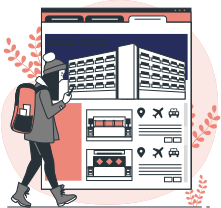
Portals, local agencies, private landlords: your home finder checks every new listing daily and contacts agencies on your behalf, so nothing slips through.
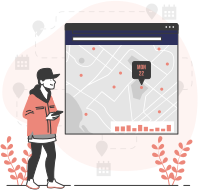
Filmed viewings, an honest report, walks through the neighbourhood at different hours. You no longer need to travel: your home finder does it all for you remotely.

Local rent levels, service charges, the state of the property, lease length. Concrete arguments to negotiate the terms — on your side, this time.

Locally required documents, guarantor, translation, review of the lease and the inventory. This is where foreign applications most often fall apart.

Inventory, key handover, utilities set-up, first admin steps. Your home finder doesn't disappear once the contract is signed: they remain a valuable contact for any questions about life on the ground.
No scams, verified homes, secure payment.
A home found in a few weeks.
Guided by a local home finder, in your language.
Everything handled remotely, stress-free.
Four steps, from your request to the signed lease.
You start by filling in a short questionnaire to tell us a bit more about your search.
One of our home finders then takes over and contacts you for a free first conversation. The goal? Understanding exactly what you need.
If it clicks and you want to move forward, you receive a tailored quote. Once approved, the search begins!
Your home finder searches for you, shares their finds, stays with you through to signing the lease — all that’s left is packing your bags.
Join a community of happy clients.
In short: Renting in Liechtenstein means navigating a very tight market with limited supply, high rents (starting from around 1,425 CHF/month for a compact flat, per ImmoScout24 2025), and strict administrative requirements. The most sought-after areas are Vaduz, Schaan, and Triesen. You will need a complete rental dossier, a valid residence permit (subject to annual quotas), and must register with your local municipality upon arrival. Start your search early, prepare your documents in advance, and factor in utilities and a security deposit of 2–3 months' rent.
Liechtenstein offers a unique combination of Alpine scenery, political stability, and a high standard of living that attracts professionals, families, and remote workers from across Europe and beyond. Key reasons to consider renting in Liechtenstein include:
Day-to-day life in Liechtenstein is comfortable, well-organised, and deeply connected to the Alpine environment. Here is what to expect once you have found your rental:
Liechtenstein's rental market is one of the most constrained in Europe. The principality covers just 160 km² and has a population of around 39,000, which means the total housing stock is extremely limited. Demand consistently outpaces supply, particularly in the main municipalities of Vaduz, Schaan, and Triesen.
Most rental listings are published on Swiss platforms such as ImmoScout24 and Homegate, as Liechtenstein does not have its own dedicated property portal. Listings are predominantly in German. The market is dominated by private landlords and small property management companies; large institutional landlords are rare.
Vacancy rates are very low, and well-priced apartments are typically rented out within days of being listed. The cultural preference in Liechtenstein leans toward long-term tenancy, so landlords tend to favour stable, financially secure tenants with verifiable income. Expats and remote workers should be prepared for a competitive process and may benefit from local networking or professional relocation support to find suitable properties.
Liechtenstein is divided into 11 municipalities (Gemeinden), each with its own character. The most popular areas for long-term rentals among expats and professionals are:
Renting a home in Liechtenstein requires a solid budget. The country uses the Swiss Franc (CHF) as its currency, and housing costs are comparable to — or higher than — those in neighbouring Switzerland. A one-bedroom apartment in Vaduz, the capital, typically costs at least 1,500 CHF per month, according to data from jarniascyril.com (2024). More spacious family apartments in the same area can easily exceed 2,500 CHF per month. Municipalities such as Schaan and Triesen offer slightly more affordable options, though the difference is modest. Budget-conscious tenants are advised to explore listings in smaller communes like Balzers or Eschen, where rents tend to be lower. Always factor in utilities, the security deposit, and any parking costs when calculating your total monthly housing expenditure.
The rental market in Liechtenstein operates in Swiss Francs (CHF), and monthly rents are among the highest in the Alpine region. According to listings on ImmoScout24 (2024–2025), entry-level apartments in Liechtenstein start from approximately 1,425 CHF per month for a compact flat, while a standard one-bedroom apartment in or near Vaduz typically ranges between 1,500 CHF and 2,200 CHF per month. Larger family apartments (3–4 rooms) can reach 2,500 CHF to 3,500 CHF per month or more depending on location and amenities.
Utilities (heating, water, electricity) are generally billed separately and can add 150 CHF to 300 CHF per month to your total housing cost. A security deposit of two to three months' rent is standard practice. Parking spaces, when not included, are typically rented separately for around 100 CHF to 150 CHF per month.
Finding a rental in Liechtenstein can be challenging, and several common mistakes can slow down or derail your search:
Here are practical tips to maximise your chances of finding and securing a long-term rental in Liechtenstein:
Finding a long-term rental in Liechtenstein can be a complex and time-consuming process, especially for newcomers unfamiliar with the local market, the German-language listings, and the strict residence permit requirements. Remoters connects you with experienced local relocation specialists who can guide you through every step of your accommodation search — from identifying suitable listings and preparing a compelling rental dossier, to reviewing your lease agreement and navigating the municipal registration process. Whether you are relocating for work, moving with your family, or settling in Liechtenstein as a remote worker, Remoters helps you find the right rental faster and with greater confidence.
Yes: it is the real bottleneck, even before the rent. Liechtenstein applies annual residence permit quotas (B permits), including for EEA and Swiss nationals, and signing a lease without checking your eligibility can make moving there impossible.
Contact the Ausländer- und Passamt as soon as your plans take shape. Many people who work there live in Buchs, Sargans or Feldkirch. Once settled, register with the Gemeinde.
Vaduz to be at the heart of the finance sector, with the highest rents; Schaan, the most populous municipality and home to Hilti, for its railway station; Triesen for a residential, family life. Triesenberg, a hillside village near Malbun, means you need a car.
The Unterland, with Eschen and Mauren, has the most affordable rents, near Feldkirch, and Balzers is handy for Sargans. Everywhere, supply is tiny: decent homes go within days.
A complete application from the start, or it is rejected outright: passport or ID, employment contract, your last three payslips and references from previous landlords, ready to send within the hour. Listings are on ImmoScout24 and Homegate, almost always in German, like the leases.
Start 3 to 6 months ahead, with email alerts. The lease follows the Swiss model: check net rent, charges, term and termination, then record the inventory with dated photos.
From 1,425 CHF a month for a compact flat, 1,500 to 2,200 CHF for a one-bedroom flat in or near Vaduz, and 2,500 to 3,500 CHF or more for a family home of 3 or 4 rooms. Add 150 to 300 CHF in charges, plus insurance.
When you move in, allow a deposit of 2 to 3 months' rent in a blocked account. The Unterland (Eschen, Mauren) is more affordable; across the border, Buchs, Sargans or Feldkirch offer more choice for the same budget.