

I describe my searchGet started
The #1 international network of home finders

Find your place in Groningen with a local home finder

For students, companies and professionals, all over the world.

Remoters puts you in touch with a home finder living there, who speaks your language, searches to your criteria, views on your behalf and stays with you through to the signed lease.

Your home finder, on site
An English-speaking home finder, based on site

They know the neighbourhoods, the rents and how the local market works, and they speak your language.

Shortlists properties and visits them for you

Listings, agencies, local network: they shortlist to your criteria and view properties on your behalf.

Backs your application and negotiates the lease

They present your application to the landlord and negotiate the lease terms for you.

Every step protected, no hidden surprises

Verified home, lease reviewed, secure payment: you sign knowing exactly what you are getting.

5,000+ clients supported
★★★★★ 4.8/5 on Google, 1,100+ reviews
220+ cities
60+ countries

What does a home finder actually do?

Six missions, from the first brief to key handover.

Illustration: scoping the search

They scope your search

Real budget, viable neighbourhoods, size, life constraints. The brief is written before the first listing — that's what saves three months of pointless viewings.

Illustration: local market specialist

They comb the whole market

Portals, local agencies, private landlords: your home finder checks every new listing daily and contacts agencies on your behalf, so nothing slips through.
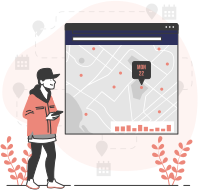
Illustration: viewings and neighbourhoods

They visit for you

Filmed viewings, an honest report, walks through the neighbourhood at different hours. You no longer need to travel: your home finder does it all for you remotely.

Illustration: price negotiation

They assess and negotiate

Local rent levels, service charges, the state of the property, lease length. Concrete arguments to negotiate the terms — on your side, this time.

Illustration: securing the application

They secure the application

Locally required documents, guarantor, translation, review of the lease and the inventory. This is where foreign applications most often fall apart.

Illustration: saving time when settling in

They stay with you until you're settled in

Inventory, key handover, utilities set-up, first admin steps. Your home finder doesn't disappear once the contract is signed: they remain a valuable contact for any questions about life on the ground.

What you get

Safety

No scams, verified homes, secure payment.

Speed

A home found in a few weeks.

Human

Guided by a local home finder, in your language.

Peace of mind

Everything handled remotely, stress-free.

How it works

Four steps, from your request to the signed lease.

1

We get acquainted

You start by filling in a short questionnaire to tell us a bit more about your search.

2

Free first call

One of our home finders then takes over and contacts you for a free first conversation. The goal? Understanding exactly what you need.

3

The adventure begins

If it clicks and you want to move forward, you receive a tailored quote. Once approved, the search begins!

4

Heading to your new home

Your home finder searches for you, shares their finds, stays with you through to signing the lease — all that’s left is packing your bags.

+5000
clients supported since 2023
+220
cities covered worldwide
+60
countries covered
+250
home finders
Groningen
Groningen is the capital of the northern Netherlands and home to the University of Groningen and Hanze University of Applied Sciences, giving the city a young, international character. Approximately 60% of its housing stock is rental, managed partly by six housing corporations including Nijestee and Lefier, and partly by the private free market. Average apartment rents stand at around 950 EUR/month according to Kamernet, with significant variation between the lively Binnenstad and more affordable outer-ring districts such as Vinkhuizen and Paddepoel. The rental market is competitive, with demand consistently outpacing supply, particularly for smaller units near the city centre and the Zernike Campus. Tenants should prepare a complete rental dossier — including proof of income, employment contract, and ID — and be ready to act quickly when a suitable listing appears.

Groningen in brief: a compact, bike-friendly university city in northern Netherlands with a highly rental-dominated housing market (60% rental stock). Average apartment rents are around 950 EUR/month (Kamernet), ranging from 500 EUR/month for a shared room to 1,800 EUR/month for a two-bedroom flat. The market is competitive — act fast, prepare a complete dossier, and consider neighbourhoods beyond the Binnenstad for better value. Register at the Gemeente Groningen after moving in to obtain your BSN number.

Groningen is the vibrant capital of the northern Netherlands and consistently ranks among the country's most liveable cities. Home to the University of Groningen (founded in 1614) and Hanze University of Applied Sciences, it has a young, international, and dynamic atmosphere that extends well beyond student life. The compact city centre — largely navigable by bicycle — is lined with canals, historic gabled houses, and a thriving cultural scene anchored by venues such as the Groninger Museum and the Stadspark.

Compared to Amsterdam, Rotterdam, or Utrecht, Groningen offers a noticeably lower cost of living, shorter commutes, and a more relaxed pace of life, while still providing excellent infrastructure, fast broadband, and a wide range of international amenities. The city is well connected by train, with Amsterdam reachable in approximately two hours. Nature is also close at hand: cycling just 15 minutes outside the city brings you to open landscapes, lakes, and the distinctive Groningen countryside. For remote workers, expats, and professionals relocating from abroad, Groningen combines affordability, quality of life, and a genuinely international community.

Day-to-day life in Groningen is practical, affordable, and largely car-free. The city is compact enough to navigate entirely by bicycle — the preferred mode of transport for most residents — and the centre is home to a wide range of supermarkets, markets (including the lively Vismarkt), independent shops, cafés, and restaurants. Public transport is reliable, and Amsterdam is reachable by direct train in approximately two hours.

Healthcare is accessible through local GP practices (huisartsen); registering with a GP shortly after arrival is strongly recommended. Health insurance is mandatory in the Netherlands and must be arranged independently — basic coverage starts at around 130 to 160 EUR/month depending on the provider and policy chosen.

The city has a strong English-speaking community thanks to its universities, and many administrative services, shops, and landlords communicate comfortably in English. The International Welcome Centre North Netherlands (IWCNN) provides practical support for newcomers, including guidance on registration, housing, and integration. For families, Groningen offers a range of international and Dutch-language schools, green parks such as the Noorderplantsoen and the Stadspark, and a cultural calendar that includes the Groninger Museum and numerous festivals throughout the year.

The Groningen rental market is one of the most distinctive in the Netherlands. According to HousingMatchers, approximately 60% of Groningen's housing stock is rental — the highest proportion of any major Dutch municipality outside the Randstad. Six housing corporations (Nijestee, Lefier, De Huismeesters, Patrimonium, Wierden en Borgen, and Woonborg) collectively manage around 32% of all homes, making social housing a genuine option for eligible tenants willing to wait.

The private rental market, however, is under significant pressure. Kamernet's Q3 2024 report recorded a 7.2% increase in average rental prices nationwide, with Groningen experiencing both surging demand and shrinking supply. The city's large student population — drawn by the University of Groningen and Hanze University of Applied Sciences — creates intense competition for smaller units and rooms, particularly in central neighbourhoods. Listings on platforms such as Pararius, Funda, Kamernet, and HousingAnywhere are often taken within days of publication. Acting quickly and having a complete rental dossier ready is essential to securing a property.

Groningen's neighbourhoods are often described as a series of concentric rings, each with its own character and rental price range:

  • Binnenstad (City Centre): The most vibrant and expensive area, with bars, restaurants, shops, and the grand Academy Building of the University of Groningen within walking distance. Expect higher rents and some noise, especially at weekends.
  • Schildersbuurt & Zeeheldenbuurt: Just west of the centre, these quiet, leafy neighbourhoods feature 19th-century Dutch-style houses and are popular with families and locals. Close to the Noorderplantsoen, one of Groningen's largest parks.
  • Oosterpoort: Considered the most alternative district, Oosterpoort attracts professionals and creatives. It borders the Stadspark and has a lively cultural scene.
  • Korrewegwijk: Known for its multicultural character and eastern influences, this up-and-coming neighbourhood offers lower rents and a diverse community.
  • Paddepoel: An affordable option with direct access to the Zernike Campus, popular with students and young professionals.
  • Helpman & De Wijert: Quiet, green neighbourhoods south of the centre, well suited to families and professionals seeking calm streets and good schools.
  • Vinkhuizen, Selwerd, Beijum: Outer-ring districts offering the most space, the largest gardens, and the lowest rents in the city — ideal for tenants prioritising value over proximity to the centre.

Groningen is one of the more affordable major cities in the Netherlands for long-term rentals, particularly when compared to Amsterdam or Utrecht. The rental market is split between the social housing sector — managed by six housing corporations including Nijestee, Lefier, and De Huismeesters — and the private free-market sector. Social housing offers lower rents but comes with waiting lists; the free market provides faster access but at higher prices. For a comfortable one-bedroom apartment in a central neighbourhood, budget at least 950 to 1,200 EUR/month. Families or professionals seeking a two-bedroom flat should plan for 1,200 to 1,800 EUR/month. Choosing a neighbourhood in the post-war ring (Paddepoel, Selwerd, De Wijert, Corpus den Hoorn) or the outer ring (Vinkhuizen, Beijum) can meaningfully reduce your monthly rent while still offering good transport links to the city centre.

Rental prices in Groningen vary significantly depending on the type of accommodation, its location, and whether it is furnished or unfurnished. According to Kamernet data, the average rent for an apartment in Groningen is around 950 EUR/month, with an average price of approximately 20 EUR per square metre per month. Shared rooms typically range from 500 to 800 EUR/month (source: AtHomeInGroningen), while furnished studios and one-bedroom apartments in the city centre can reach 900 to 1,400 EUR/month. Two-bedroom unfurnished flats generally fall between 1,200 and 1,800 EUR/month (source: RentHunter). Outer-ring neighbourhoods such as Vinkhuizen, Paddepoel, and Selwerd offer more space at lower monthly rents, making them attractive for tenants on tighter budgets. Utilities (gas, water, electricity) are often billed separately and can add 100 to 200 EUR/month to your total housing costs.

Renting in Groningen can be competitive, and several common mistakes can slow down or derail your search:

  • Starting too late: The Groningen rental market moves fast, especially in summer. Begin your search at least 6 to 8 weeks before your intended move-in date.
  • Incomplete rental dossier: Landlords typically require proof of income, a recent employment contract, a copy of your ID or residence permit, and recent bank statements. Missing documents will cost you the listing.
  • Ignoring income requirements: Most private landlords in the Netherlands require a gross monthly income of 3 to 4 times the monthly rent (source: HelloHousing). Make sure you meet this threshold before applying.
  • Overlooking outer-ring neighbourhoods: Many tenants focus exclusively on the Binnenstad or Schildersbuurt and miss more affordable, well-connected options in Paddepoel, Selwerd, or Vinkhuizen.
  • Not verifying the lease contract: Always check that your rental agreement is in writing and complies with Dutch tenancy law. The Rent Support Centre Groningen (Steunpunt Huren Groningen) offers free advice to tenants.
  • Paying an excessive deposit: Under the Good Landlordship Act, landlords may not require more than two months' basic rent as a security deposit. Any higher demand is unlawful.
  • Signing without a property visit: Always visit the property in person or via a trusted representative before signing a lease to avoid unpleasant surprises.
  • Start early: The Groningen rental market is highly competitive, especially in summer. Begin your search 6 to 8 weeks before your planned move-in date and set up alerts on Pararius, Funda, and Kamernet.
  • Have your dossier ready: Prepare your ID, payslips, employment contract, and bank statements before you start applying. Landlords move fast and will favour applicants who can submit documents immediately.
  • Check the income requirement: Most private landlords require a gross monthly income of 3 to 4 times the rent. Calculate this before applying to avoid wasted time.
  • Consider outer-ring neighbourhoods: Districts like Paddepoel, Selwerd, Vinkhuizen, and Corpus den Hoorn offer significantly lower rents and are easily accessible by bike or public transport.
  • Verify your lease: Ensure your rental contract is in writing and complies with Dutch tenancy law. The Steunpunt Huren Groningen (Rent Support Centre) offers free advice to tenants.
  • Know your deposit rights: Under the Good Landlordship Act, your landlord cannot ask for more than two months' basic rent as a security deposit.
  • Register at the municipality: After moving in, register your address at the Gemeente Groningen to obtain your BSN number — essential for banking, healthcare, and other services.
  • Use multiple platforms: Cross-list your search across Pararius, Funda, Kamernet, HousingAnywhere, and HousingMatchers to maximise your chances of finding a suitable property.

Finding a long-term rental in Groningen can be challenging, especially if you are relocating from abroad or navigating the Dutch rental market for the first time. Remoters connects you with local rental search specialists who know the Groningen market — from the competitive Binnenstad to the more affordable outer-ring neighbourhoods. Whether you need help building a strong rental dossier, identifying the right neighbourhood for your lifestyle and budget, or managing viewings and lease negotiations remotely, Remoters can match you with the right support for your situation.

What our clients say

Claire
Christine
Claire
Very good experience with Claire. Actions very clearly explained, no surprises. I recommend.
Vanessa
Agathe
Vanessa
Thanks a lot to Vanessa for her help and enthusiasm :)
Hélène
Alain
Hélène
Impeccable, very helpful and always giving good advice and very quick to provide you with information. Thank you, bravo to her
Gaelle
John
Gaelle
Excellent service provided by Gaelle Eventually we found a suitable place Initially I thought was a bit pessimistic but it all worked out in the end

The deposit (waarborgsom) has been capped at two months' base rent since July 2023 and must be returned within 14 days of the end of the lease. Since 1 July 2024, the mid-rent segment has been capped at about 1,158 EUR a month, for homes up to 186 WWS points.

Insist on a written contract: without one, you cannot register with the gemeente or get a BSN. If in doubt, the Steunpunt Huren Groningen gives free legal advice.

Never pay a deposit or advance before viewing the home and signing a written contract. Also refuse any deposit above two months' base rent: it has been illegal since July 2023.

Search on specialist platforms, Pararius, Funda, Kamernet, Kamer.nl or HousingAnywhere, and have the home viewed if you are far away: depending on the quote, your home finder views for you with photos or video. If in doubt, contact the Steunpunt Huren Groningen.

From April, as the University of Groningen advises: demand soars in August and September, with about 40,000 students between the RUG and the Hanzehogeschool, and the city is short of some 7,400 homes.

Get your ID, proof of enrolment or bank statements, a short cover letter and, if possible, a guarantor letter ready early. A shared room rents for 400 to 600 EUR a month, a studio for about 896 EUR.

Paddepoel and Selwerd, near the Zernike campus, multicultural Korrewegwijk and historic Oosterpark have the most affordable rents. The Centrum and the Schildersbuurt, near the Noorderplantsoen, are the most sought after; Helpman and De Wijert suit families.

Allow 900 to 1,365 EUR a month for a one- or two-room flat. Ask whether the rent is all-in or exclusief: bills often add 200 to 265 EUR a month.