


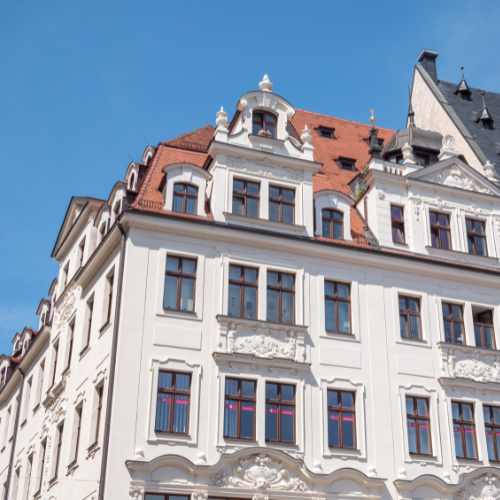

Buying property à Anvers with a dedicated expert

Drapeau du Royaume-Uni avec des bandes rouges, blanches et bleues en forme de croix et de diagonales.
An English-speaking Home Finder who lives there
Emoji de détective avec chapeau, loupe et cheveux gris.
Sees the good places before they hit the market
Médaille d'or avec un ruban rouge indiquant la première place.
Fights for your offer, not the seller's
Symbole dollar vert sur fond blanc.
The real local price, not the foreigner tax

What kind of property are you looking for à Anvers?

Describe your project, one of our real estate hunters will look for the ideal property for you

Why work with a property hunter?

Time spent by the buyer
Symbole d'information en cercle bleu foncé sur fond transparent.
When you search alone, about 85% of the time is spent on research, and 15% on visits. With a hunter, you only do the visits
Icône de fermeture (croix)
Access to the off-market
Purchase price
Virtual pre-visits
Secure formalities
Symbole d'information en cercle bleu foncé sur fond transparent.
Customer satisfaction
Only 20% of satisfied buyers according to the 2018 Crédit Foncier study. For its part, Remoters gets a score of 4/5 or 5/5 in 95% of cases
Icône de fermeture (croix)

Buying alone abroad

140 hours
Icône rouge de croix X sur fond blanc.
Very difficult negotiation
Icône rouge de croix X sur fond blanc.
20%

Buying  with Remoters

20:00
14% discount obtained on average
95%
Photo of Noémie, home finder in Anvers

Noémie, or another expert property hunter based à Anvers, will personally manage your search.

Guide local de l’achat immobilier

Acheter un bien immobilier

Buying property in Antwerp in under 30 seconds: here is what you need to know.

Antwerp is Belgium's second city and a major economic hub. No restrictions apply to foreign buyers — the purchase process is identical for Belgians and non-residents alike. The market is active, with prices averaging around €2,805 per m² across all property types (Immoweb, August 2025). The acquisition process involves two key steps: signing a binding preliminary agreement (verkoopcompromis), then completing the purchase before a notary within two to four months. Total acquisition costs — including registration duties, notary fees, and related expenses — typically add 10 to 15% on top of the purchase price. In Flanders, the registration duty for a primary residence is 2% as of January 2025; for a second home or investment, the rate is 12%. New builds are subject to 21% VAT. Non-residents can obtain a Belgian mortgage but should expect a lower loan-to-value ratio of 70 to 80% and a larger down payment. The market rebounded strongly in 2025, with transaction volumes up over 21% year on year nationally.

Prix par type de bien

Fourchettes de prix selon la surface, la typologie et l’usage du logement.

Purchase prices in Antwerp vary significantly by property type. The following figures are based on Immoweb price estimates as of 1 August 2025 (prices expressed as net seller price per m²):

  • Apartments: The average purchase price for apartments in Antwerp city ranges from €2,289 to €3,827 per m², with an average of approximately €2,900 per m², depending on the zone and property characteristics (source: Immoweb, August 2025).
  • Houses: Houses have a lower average price per m² than apartments in Antwerp, at approximately €2,614 per m² on average, ranging from €1,949 to €3,472 per m² — a difference of approximately -10.91% compared to apartments (source: Immoweb, August 2025).
  • New-build properties: New constructions command a premium over existing stock and are subject to 21% VAT rather than registration duty. In Ghent — a comparable Flemish city — new-build apartment prices reached an average of €4,223 per m² in 2025, illustrating the premium attached to new construction in Flanders (source: Deloitte Property Index 2025).
  • Studios and small apartments: Entry-level units in more affordable Antwerp districts offer lower absolute prices, making them accessible to first-time buyers and investors.
  • Townhouses and heritage properties: Belle Époque and Art Nouveau townhouses in Zurenborg or 't Zuid command significant premiums above the city average, reflecting their architectural rarity and strong demand.

Prix et profils des quartiers

Les secteurs à comparer selon le budget, le mode de vie et le projet d’achat.

Antwerp's property purchase market is highly segmented by neighbourhood, with significant price variations reflecting each district's character, connectivity, and demand profile.

  • Eilandje (Port district): Antwerp's redeveloped waterfront district around the MAS museum offers contemporary apartments popular with expats and investors. It commands premium purchase prices, driven by modern finishes and a trendy atmosphere.
  • 't Zuid (South district): A cultural quarter attracting young professionals and creatives, with galleries, restaurants, and proximity to the Royal Museum of Fine Arts. Purchase prices are among the highest in the city, reflecting strong demand and limited supply.
  • Zurenborg: Known for its Belle Époque and Art Nouveau architecture along the Cogels-Osylei and around Dageraadplaats, Zurenborg is one of Antwerp's most desirable residential areas. Properties here are described as quite expensive, with limited availability (source: Neighbourhoods in Antwerp guide). The northern part has a village atmosphere popular with families; the southern part features distinctive townhouses.
  • Berchem and Wilrijk: More suburban districts offering larger properties, green spaces, and good schools, well-connected to the city centre. Purchase prices are more moderate than in the central districts, making them popular with families.
  • Borgerhout and Deurne: More affordable districts where purchase prices are lower, attracting budget-conscious buyers and investors seeking higher yield potential (source: Investropa, early 2026).

According to Immoweb (price estimates as of 1 August 2025), the average purchase price per m² across all property types in Antwerp city is €2,805, with apartments ranging from €2,289 to €3,827 per m² depending on the zone, and houses averaging €2,614 per m² (range: €1,949 to €3,472 per m²) (source: Immoweb, August 2025).

Évolution du marché immobilier

Dynamique des prix, niveau de demande et biens les plus recherchés.

The Antwerp property purchase market has followed the broader Belgian residential market trajectory over recent years, with distinct phases of growth, stabilisation, and renewed activity.

Belgium recorded a modest national price increase of +1.3% in 2024, one of the lowest among European countries surveyed, reflecting the impact of higher financing costs on buyer purchasing power (source: Deloitte Property Index 2025). In 2023–2024, the market showed signs of stabilisation: nominal price growth remained positive but slower, while real outcomes were constrained by inflation and affordability pressure (source: Belgium's Residential Property Market Analysis 2026).

A clear rebound in sales activity emerged in 2025. Based on Statbel transaction records, 111,249 existing dwellings were sold across Belgium in Q1–Q3 2025, up 21.42% year on year (source: Belgium's Residential Property Market Analysis 2026). This recovery was supported by consecutive ECB interest rate cuts, which progressively improved borrowing conditions. The average mortgage interest rate in Belgium fell to 3.5% in November 2025, down from a peak of 5.52% in October 2023 (source: Expatica, 2025).

Antwerp, as Belgium's second-largest city and an economic hub, benefits from sustained urban demand. Strong urbanisation trends — with 98.19% of Belgians living in cities as of 2023–2024 — continue to support demand for property in major cities including Antwerp (source: Investropa, 2024). Supply constraints persist, as the number of new project starts in Belgium dropped by more than 8% in 2024, raising questions about future availability (source: Deloitte Property Index 2025).

Budget total et fiscalité

Prix d’acquisition, taxes, honoraires et dépenses à prévoir en complément.

When purchasing property in Antwerp, the total acquisition budget must include the purchase price plus a set of mandatory additional costs that typically represent 10 to 15% of the purchase price (source: Investropa, 2025).

  • Registration duty (registratierechten): Antwerp is located in Flanders. As of 1 January 2025, the Flemish government reduced the registration duty to 2% for the purchase of a sole and primary residence (source: BDO Belgium / Lexunion, 2025). For a second home or investment property, the standard Flemish rate of 12% applies (source: Investropa, 2025).
  • VAT on new-build properties: New constructions are subject to 21% VAT instead of registration duty on the building portion; the land component remains subject to the standard registration duty rate (source: FPS Finance Belgium / Investropa, 2025).
  • Notary fees: Set by Royal Decree, notary fees are regulated and typically represent approximately 1 to 1.5% of the purchase price, plus administrative costs (source: Investropa, 2025).
  • Mortgage-related costs: If financing through a mortgage, additional notary and registration costs for the mortgage deed apply — generally estimated at around 1.3% of the loan amount, plus a property valuation fee (source: Investropa, 2025).
  • Abatement (woonbonus abatement): In Flanders, buyers of a primary residence may benefit from an exemption on the first €200,000 of the taxable base, subject to conditions including personal occupation and registration (source: Notary fees Belgium / Investropa, 2025).

There is no capital gains tax on the sale of a primary residence in Belgium for private individuals, provided standard holding conditions are met. Annual property tax (onroerende voorheffing) is levied on the cadastral income of the property.

Étapes de l’acquisition

Le déroulement du projet depuis la définition des critères jusqu’à la remise des clés.

Buying property in Antwerp follows a structured legal process governed by Belgian and Flemish law. The key steps are as follows:

  1. Property search and viewings: Identify properties through platforms such as Immoweb or Zimmo, or via a local estate agent. Visit properties and request all mandatory certificates from the seller.
  2. Mortgage pre-approval (if applicable): Approach Belgian banks or specialist brokers to obtain a financing agreement in principle before making an offer.
  3. Making an offer: Submit a written offer to the seller or their agent. Once the seller accepts, both parties are in principle bound by the agreement on price and property.
  4. Signing the preliminary sale agreement (verkoopcompromis / compromis de vente): This private deed is legally binding on both parties. It sets out the price, conditions, and a completion deadline. The buyer typically pays a deposit of 10% of the purchase price at this stage, held in escrow by the notary.
  5. Notary due diligence period: The notary carries out all legal searches, verifies title, checks for encumbrances, requests mandatory certificates, and prepares the authentic deed. This period generally lasts two to four months.
  6. Signing the authentic notarial deed (notariële akte): Both buyer and seller sign before the notary. The buyer pays the balance of the purchase price, registration duties, and all notary fees. Legal ownership transfers at this moment.
  7. Registration of the deed: The notary registers the deed with the Administration of Legal Security within fifteen days of signing. Registration duties must be paid within four months of the preliminary agreement (source: DLA Piper REALWORLD / Expat Focus Belgium).
  8. Handover of keys: Once the deed is registered and all payments are settled, the keys are handed over to the buyer.

Documents nécessaires

Les justificatifs à préparer pour acheter et financer un bien en Italie.

Purchasing property in Antwerp requires the buyer to gather and present a number of documents throughout the acquisition process. The seller is also legally required to provide specific certificates before the sale can be completed in Flanders.

  • Buyer identification: Valid passport or national identity card; for non-EU nationals, a valid residence permit or visa documentation.
  • Proof of financing: Mortgage pre-approval letter or proof of available funds (bank statements or confirmation from a financial institution).
  • Energy Performance Certificate (EPC): Legally required upon sale in Flanders; must be provided by the seller before the property is listed (source: Flanders.be).
  • Soil certificate (bodemattest): Issued by OVAM (Public Waste Agency of Flanders), this certificate confirms whether the land is registered as potentially contaminated (source: Mandatory documents for real estate transactions, Flanders).
  • Urban planning information (stedenbouwkundige inlichtingen): Confirms zoning, building permits, and any planning infringements affecting the property (source: Due diligence and certificates for purchasing luxury real estate in Belgium).
  • Electrical installation inspection report: Required for existing properties; indicates whether the electrical installation is compliant or lists non-conformities.
  • Flood risk information: In Flanders, the P-score and G-score indicate the property's flood risk level.
  • Cadastral extract: Identifies the property, its owner, surface area, and cadastral income.
  • Co-ownership documents (for apartments): Syndic reports, minutes of general meetings, building reserve fund balance, and any outstanding charges.
  • Tax identification number (if applicable): Non-resident buyers may need to obtain a Belgian tax identification number for the notarial deed.

Vérifications juridiques et techniques

Contrôles du titre, du cadastre, de la conformité et de l’état réel du bien.

Before committing to a property purchase in Antwerp, buyers must carry out thorough legal and technical due diligence. In Flanders, several certificates are legally mandatory and must be provided by the seller.

  • Energy Performance Certificate (EPC / Energieprestatiecertificaat): Legally required upon sale in Flanders. Must be available before the property is listed. Failure to provide it can result in a fine of between €500 and €5,000 (source: Flanders.be). The EPC indicates the property's energy efficiency rating and is increasingly important given Flemish renovation obligations.
  • Soil certificate (bodemattest): Issued by OVAM, this certificate confirms whether the land is registered as potentially contaminated. Mandatory for all property sales in Flanders (source: Mandatory documents for real estate transactions, Flanders).
  • Urban planning information (stedenbouwkundige inlichtingen): Verifies zoning, building permits, any planning infringements, and the legal use of the property. Essential to confirm that any extensions or modifications were properly permitted (source: Due diligence and certificates for purchasing luxury real estate in Belgium).
  • Electrical installation inspection: Required for existing properties. Identifies any non-compliances that the buyer may need to rectify after purchase.
  • Flood risk assessment: In Flanders, the P-score and G-score indicate the property's exposure to pluvial and fluvial flooding — a growing consideration for buyers (source: Due diligence and certificates for purchasing luxury real estate in Belgium).
  • Cadastral and title verification: The notary verifies the chain of title, checks for mortgages, liens, easements, or other encumbrances registered against the property.
  • Co-ownership due diligence (for apartments): Buyers should review syndic reports, minutes of general meetings, the building's reserve fund balance, and any outstanding charges or planned major works.
  • Structural and technical inspection: While not legally mandatory, buyers are strongly advised to commission an independent structural survey, particularly for older properties, to identify hidden defects before signing the preliminary agreement.

Financement des non-résidents

Apport, crédit, justificatifs et contraintes propres aux acquéreurs étrangers.

Belgium imposes no nationality-based restrictions on property ownership, meaning foreign buyers and non-residents can purchase property in Antwerp under the same legal framework as Belgian citizens (source: Expat Focus Belgium). However, financing conditions differ significantly for non-residents.

  • Loan-to-value (LTV) ratios: Belgian banks typically finance 80 to 90% of the purchase price for residents with stable income and good credit history. Non-residents and foreign buyers usually receive lower LTV ratios of 70 to 80%, requiring a larger down payment (source: Investropa, September 2025).
  • Down payment: Non-residents should expect to provide a down payment of 20 to 30% of the purchase price, compared to 10% for residents (source: Investropa, 2025).
  • Interest rates: Mortgage interest rates in Belgium were around 3 to 4% as of mid-2025, with the average rate in 2024 at 3.4%, below the EU average of 4.34% (source: Expatica, 2025).
  • Mortgage term: Most Belgian mortgages last between 10 and 25 years, with a maximum term of 30 years. Fixed-rate loans are the most common product (source: Expatica).
  • Required documentation for non-residents: Proof of income (payslips, tax returns, employment contract), bank statements, credit history documentation, and in some cases the opening of a Belgian bank account.
  • Notarisation of the mortgage: The mortgage must be registered in authentic form by a notary, in addition to the purchase deed — meaning two separate notarial acts are generally required (source: Buying property in Belgium — Information for expats).
  • Alternative financing: For buyers unable to secure a standard bank mortgage, alternative options include private banks, insurance company lenders, or specialist international mortgage brokers with experience in the Belgian market.

Investissement et potentiel locatif

Demande locative, loyers, rendement indicatif et règles à anticiper.

Antwerp is one of Belgium's most active property investment markets, driven by its status as the country's second-largest city, its port economy, its university population, and sustained urban demand.

  • Gross rental yields: The average gross rental yield in Belgium stood at 4.32% in Q1 2026, up from 4.21% in Q3 2025 (source: Global Property Guide / rental yield analysis, Q1 2026). In more affordable Antwerp districts such as Borgerhout and Deurne, gross yields can reach 4.5 to 6%, nearly double the national average for well-selected assets (source: Investropa, early 2026).
  • Student housing: Student properties (kots) in Antwerp generally offer gross yields of 5 to 7%, supported by constant demand from the city's large student population, though with higher tenant turnover (source: Investropa, 2025).
  • Premium districts: In sought-after areas such as 't Zuid and Eilandje, purchase prices are higher, which compresses yields but offers stronger capital appreciation potential.
  • New-build investment: New constructions are subject to 21% VAT, which increases the acquisition cost and must be factored into yield calculations.
  • Tax on rental income: For private individuals in Belgium, rental income from residential property is generally taxed on the basis of the indexed cadastral income rather than actual rent received, unless the property is rented to a company or for professional use.
  • Market dynamics: Supply constraints — with new project starts falling by more than 8% in 2024 — support the long-term investment case for well-located Antwerp properties (source: Deloitte Property Index 2025).

Méthode de négociation

Analyse du juste prix et arguments employés pour défendre l’offre d’achat.

Negotiating a property purchase in Antwerp follows Belgian market conventions, where listed prices are generally considered a starting point for discussion.

  • Listed prices are negotiable: Properties for sale in Belgium are known to have negotiable prices; the standard approach is to make an initial offer below the asking price (source: Expatica Belgium).
  • Market conditions matter: In high-demand Antwerp neighbourhoods such as Zurenborg, 't Zuid, or Eilandje, competition among buyers can be strong, limiting room for negotiation. In less sought-after districts, price reductions of several percentage points are more common.
  • Written offer: Offers should be submitted in writing, specifying the proposed price, any conditions (such as subject to financing), and a validity period. Once the seller accepts in writing, both parties are in principle bound.
  • Conditions precedent: Buyers may include a financing condition (opschortende voorwaarde) in the offer, making the purchase conditional on obtaining a mortgage. This protects the buyer if financing is refused.
  • Deposit at compromis: Upon signing the preliminary sale agreement, the buyer typically pays a deposit of 10% of the agreed purchase price. If the buyer withdraws without a valid condition precedent, this deposit is forfeited. If the seller withdraws, they must repay double the deposit.
  • Role of the agent: The estate agent acts on behalf of the seller and manages the negotiation process. Buyers may appoint their own buyer's agent or negotiate directly.
  • Bidding platforms: Some properties in Belgium are sold via the online bidding platform Biddit.be, where buyers submit sealed bids and the highest bidder is selected (source: Buying property in Belgium — Information for expats).

Honoraires et contenu de la prestation

Mode de rémunération, services inclus et éventuels frais complémentaires.

In Belgium, real estate agent fees are not regulated by law and are freely negotiated between the agent and the seller. The following applies to the Antwerp purchase market:

  • Agent commission: Agencies generally charge between 2% and 5% excluding VAT of the sale price, with higher percentages applying to lower-value properties (source: Bricksquare / Expatica Belgium, 2025). On average, most agents charge around 3% of the sale price (source: Expatica Belgium, 2025).
  • VAT on commission: 21% VAT applies on top of the agent's commission.
  • Who pays: Agent fees are most often the responsibility of the seller and are only payable upon successful completion — at the time of signing the notarial deed (source: Bricksquare).
  • Negotiability: Commission rates are contractual and can be negotiated when signing the sales mandate (source: Understanding real estate agent commission in Belgium).
  • Scope of services: A standard agent mandate typically covers property valuation, listing and marketing, organisation of viewings, management of offers and negotiations, coordination with the notary, and assistance with mandatory certificates.
  • Notary fees: Separate from agent fees, notary fees are set by Royal Decree and are shared between buyer and seller notaries if each party appoints their own — the total fee does not increase when two notaries are involved (source: Buying property in Belgium — Information for expats).

Préparez votre achat immobilier

Décrivez votre projet, votre budget et vos critères. Un chasseur local peut rechercher les biens, organiser les visites, vérifier les informations et vous accompagner pendant la négociation.

Décrire mon projet

How does it work?

1

Your home finder researches the ideal property based on your criteria.

2
They conduct property viewings, some on your behalf, others with you in person or remotely.
3
They negotiate the price and terms on your behalf. The hunter is still at 100% on the buyer's side.
4
They assist you until all documents are signed
5
It accompanies you until the signature of all documents, to avoid pitfalls.
Couple allongé sur le lit, pieds contre la tête de lit, s'enlaçant et regardant l'un l'autre.

Our hunters around the world!

Remoters continues to grow!
We are recruiting new hunters, do not hesitate to apply.
Carte du monde en trois panneaux avec des marqueurs rouges indiquant des emplacements en Amériques, Europe, Afrique et Asie.I am applying

FAQ

Une main portant un bracelet noir pointe sur l'écran d'un ordinateur portable tandis qu'une autre main tape.

Why choose an English-speaking home finder à Anvers?

Searching for a property abroad requires time, organization, and a good understanding of local regulations, which may differ from those in France (notaries, land registry, taxation, etc.). A property hunter helps simplify the process by managing the search, selecting relevant properties, organizing viewings, and reviewing legal documents.

They work closely with the buyer to define clear criteria, identify suitable opportunities, and negotiate the best possible price. They may attend property visits on the buyer’s behalf or accompany them during a stay in Istanbul.

Thanks to their local network, the home finder also facilitates the legal and logistical steps of the purchase. From the initial search to the final signature, they provide tailored support and help ensure a smooth and secure buying experience.

Une personne porte une chemise à carreaux et utilise une calculatrice bleue sur un bureau en bois.
How much does the Remoters home finder service cost?

Remoters works with home finders around the world. Since real estate prices vary greatly depending on the location, it is difficult to apply a single pricing structure.

Each home finder sets their own fees based on the complexity of the project and the local market. You can contact them directly to learn more about their terms and evaluate the value they can bring to your purchase.

In many cases, the home finder’s fee is largely offset by negotiating a better purchase price and helping reduce legal and administrative risks.

Main tenant holding keys with house-shaped keychain near a door lock.
Will I have access to all the offers on the market?

There are three main types of property listings on the real estate market:

  • Agency listings
  • Private listings (from individual sellers)
  • “Off-market” opportunities, meaning properties that are not yet publicly advertised

When searching on your own, you will usually access the first two categories, provided you are familiar with the main listing platforms and able to identify outdated or misleading ads sometimes used to attract buyers.

Property hunters can provide access to all three types of opportunities. They screen listings before presenting them and leverage their network to identify relevant off-market properties.

Off-market does not mean properties remain hidden indefinitely. Rather, it refers to opportunities shared before public release, allowing buyers to position themselves early. Thanks to their professional network, a property hunter can help increase access to these early opportunities.

Cuisine moderne avec évier double, robinet chromé, cuisinière à gaz et décorations vertes et citrons jaunes.
Home finder vs real estate agent

When searching for a property abroad, your need is typically a home finder🕵️

A real estate agent represents the seller through a sales mandate and aims to market properties to potential buyers.

A home finder, on the other hand, represents the buyer through a search mandate. They do not have properties to sell. Instead, they search for a specific property based on the buyer’s criteria, sourcing opportunities from both private sellers and agencies.

While the real estate agent advises and supports the seller throughout the transaction, the home finder advises and assists the buyer at every step of the purchasing process, always acting in the buyer’s best interest.

Un homme en costume tenant une petite maison colorée dans sa main devant une calculatrice.
How do you choose the right home finder?

The right home finder is the one who helps you purchase a property that best matches your needs and criteria, at an optimized price.

Their fees should remain reasonable and create real value for your project. In many cases, the cost of the service is largely offset by stronger negotiation outcomes and better purchase conditions 🤑

When buying abroad, working with a French-speaking property hunter who is well established in the local market can be particularly beneficial. This helps reduce misunderstandings and increases your chances of accessing high-quality opportunities through their local network.

Deux mains d'hommes serrées en signe de poignée de main, fond beige neutre.

Interested in becoming a home finder for Remoters à Anvers ?

You should have:

🧙 Strong experience in the local real estate market
🌐 A solid network to access a wide range of property opportunities
⚖️ In-depth knowledge of local regulations
💸 Excellent negotiation skills
🛎️ Above all, a genuine desire to support clients in their property purchase projects

If this sounds like you, we encourage you to apply — we would be happy to welcome you to our network.

Button TextButton Text