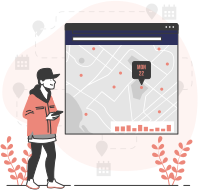

Find a place in Phnom Penh within 4 weeks

Emoji de détective avec chapeau, loupe et cheveux gris.
Shortlists properties and visits them for you

Icône de deux mains se serrant avec des flèches bleues au-dessus symbolisant un accord ou partenariat.
Backs your application and negotiates the lease

Icône de bouclier vert avec une coche blanche, symbole de sécurité ou d'assurance.
Every step protected, no hidden surprises

Why choose a home finder ?

Bruno, ou un autre de nos chasseurs to Phnom Penh, prendra en charge votre recherche

Photo chasseur immobilier - Bruno - Phnom Penh

Bruno, ou un autre de nos chasseurs to Phnom Penh, prendra en charge votre recherche

Reliability of listings
Your hunter is there to select the goods, he visits them, alone, with you in person, or with you by video. And above all, he knows how to rely on reliable business partners who only present him with quality goods.
A pen icon
Market access
Your hunter can offer you his own goods, he also has access to all the offers published on the market, and even to quite a few off market offers
A pen icon
Scam risk
At Remoters, we no longer count the number of French people who have signed a rental contract abroad, without understanding it. Some unscrupulous sellers take advantage of this to insert conditions that are disadvantageous for the tenant. This cannot happen when the contract is reviewed by our hunter.
A pen icon
Access to local prices
Symbole d'information en cercle bleu foncé sur fond transparent.
When you search alone, about 85% of the time is spent on research, and 15% on visits. With a hunter, you only do the visits
A pen icon
Application accepted
In areas where homeowners have plenty of candidates to choose from, they rarely choose foreigners first. Your hunter will use his influence (and his mastery of the language) to put your case before others.
A pen icon
Satisfaction
Only 20% of satisfied buyers according to the 2018 Crédit Foncier study. For its part, Remoters gets a score of 4/5 or 5/5 in 95% of cases
A pen icon

Browsing online listings

Weak
Weak
Elevated
Icône rouge de croix X sur fond blanc.
Uncertain
20%

Finding with Remoters

Total
Total
Weak
Very likely
95%
Phnom Penh
Phnom Penh is Cambodia's capital and a well-established destination for long-term expat tenants, with a rental market priced almost entirely in US dollars. The most popular residential neighbourhoods for foreigners include BKK1 (Boeung Keng Kang 1), Tonle Bassac, Daun Penh, and Toul Kork, each offering a distinct lifestyle and price range. One-bedroom apartments in central districts typically rent for 500–800 USD/month, while budget options in areas like Sen Sok or Toul Tumpung start from around 250 USD/month. Leases generally run for 12 months, with a security deposit of 1–2 months' rent required upfront, and landlords are legally obliged to register foreign tenants in the national FPCS system. Utilities — electricity, water, and internet — are often billed separately and can add 100–190 USD/month to the total cost of renting.

Phnom Penh in brief: A well-supplied long-term rental market priced in USD, with options from ~250 USD/month (budget studios, outer districts) to 2,000+ USD/month (premium serviced apartments in BKK1 or Tonle Bassac). Top expat neighbourhoods are BKK1, Tonle Bassac, Daun Penh, and Toul Kork. Standard leases run 12 months with a 1–2 month deposit. Landlords must register foreign tenants in the national FPCS system. Utilities are usually billed separately. The rental process is negotiable and relatively straightforward with the right preparation.

Phnom Penh attracts long-term residents for a combination of practical and lifestyle reasons. As Cambodia's capital and largest city, it offers a full range of urban infrastructure — international schools, private hospitals, modern shopping centres such as AEON Mall, and a thriving café and restaurant scene — at a cost of living that remains competitive by regional standards.

The city's expat community is well-established, with active social networks, coworking spaces, and international schools including Northbridge International School and International School of Phnom Penh (ISPP). The Mekong River and Tonle Sap confluence gives the city a distinctive riverside character, with the Riverside promenade serving as a popular leisure area.

For remote workers and digital nomads, Phnom Penh offers reliable internet infrastructure, a growing number of coworking hubs, and a relatively straightforward long-stay visa process. The city's compact size makes it easy to navigate by tuk-tuk or motorbike, and the combination of local markets, street food, and international dining options suits a wide range of lifestyles and budgets.

Day-to-day life as a long-term tenant in Phnom Penh is generally comfortable and well-serviced. Supermarkets stocking both local and imported goods — including Lucky Supermarket, AEON Mall, and various international mini-marts — are accessible across central districts. International healthcare is available at facilities such as Royal Phnom Penh Hospital and Calmette Hospital. For families, international schools including Northbridge International School and ISPP (International School of Phnom Penh) are located in or near the main expat neighbourhoods.

Getting around the city is typically done by tuk-tuk, motorbike taxi, or ride-hailing apps such as Grab and PassApp. Traffic can be heavy during peak hours, particularly in central districts. Internet connectivity is generally reliable, with monthly plans averaging 29–37 USD/month (source: IPS Cambodia, 2024). The local currency is the Cambodian Riel (KHR), but US dollars are accepted almost universally for rent, shopping, and services. Street food is widely available and very affordable, while the city's café scene — particularly in BKK1 and Toul Tumpung — caters well to remote workers.

Phnom Penh's long-term rental market is dynamic and well-supplied, with a wide range of options from basic local apartments to fully serviced high-rise condominiums. The market caters strongly to the city's large and growing expatriate community, with dedicated listings on platforms such as Khmer24, realestate.com.kh, and IPS Cambodia.

Rentals are almost universally priced in US dollars, and the market is largely informal — there is no strict regulatory framework governing deposits or lease terms, so practices vary by landlord. Most landlords prefer a minimum 12-month lease, though 6-month agreements are available, usually at a slight premium. Short-term rentals under 3 months are limited and typically more expensive per month.

Central districts such as BKK1 (Boeung Keng Kang 1), Tonle Bassac, and Daun Penh command the highest rents and offer the densest concentration of serviced apartments, international restaurants, and amenities. Suburban areas like Sen Sok and Chroy Changvar are growing rapidly and offer more affordable options with newer housing stock.

Phnom Penh is divided into distinct districts, each with its own character and rental profile. The most popular areas for long-term expat tenants include:

  • BKK1 (Boeung Keng Kang 1): The most sought-after expat neighbourhood, packed with international restaurants, cafés, serviced apartments, gyms, and embassies. Rents are among the highest in the city, with one-bedroom apartments typically starting from 500–650 USD/month.
  • Tonle Bassac: A modern, upscale area adjacent to BKK1, known for high-rise condominiums, AEON Mall, and a mix of business and lifestyle amenities. Popular with professionals and corporate tenants.
  • Daun Penh: The historic heart of the city, close to the Royal Palace and the Riverside promenade. Blends colonial architecture with local life and business centres. Rental prices start from around 600–1,500 USD/month depending on property type.
  • Toul Kork (TK): A calm, residential district favoured by families, offering spacious apartments and villas, wide streets, and access to international schools and supermarkets. More affordable than BKK1.
  • Toul Tumpung (Russian Market area): A lively, budget-friendly neighbourhood popular with younger expats and digital nomads, known for its café culture and the Toul Tumpung Market.
  • Sen Sok: A rapidly developing suburban district offering newer housing stock at more affordable rents, with growing retail and dining infrastructure.

Renting long-term in Phnom Penh is accessible across a wide range of budgets. The rental market operates almost entirely in US dollars, and prices vary significantly by neighbourhood, building quality, and included services. A single professional can live comfortably in a furnished one-bedroom apartment in a central district for 500–800 USD/month in rent, plus utilities. Families or those seeking more space will find well-appointed two- or three-bedroom apartments in residential areas like Toul Kork or Chamkarmon for 900–1,800 USD/month. Compared to other Southeast Asian capitals, Phnom Penh remains relatively affordable for the level of comfort and amenities on offer.

Phnom Penh's long-term rental market is priced almost exclusively in US dollars (USD), making budgeting straightforward for international tenants. Entry-level furnished studios in outer districts such as Sen Sok or Mean Chey can be found from around 250 USD/month, while a comfortable one-bedroom apartment in a central expat neighbourhood like BKK1 typically starts at 500–650 USD/month. Two-bedroom units in mid-range buildings range from approximately 700–1,200 USD/month, and premium serviced apartments or large condos in Tonle Bassac or Daun Penh can reach 2,000 USD/month or more.

On top of rent, tenants should budget for utilities separately: electricity (heavily influenced by air-conditioning usage) typically adds 65–150 USD/month, water around 1–5 USD/month, and internet approximately 29–37 USD/month (source: IPS Cambodia, 2024). Many serviced apartments bundle utilities into the monthly rent, which simplifies cost management for new arrivals.

Finding and securing a long-term rental in Phnom Penh typically follows these steps:

  1. Define your budget and neighbourhood priorities: Decide whether you prioritise central access (BKK1, Daun Penh), family-friendly space (Toul Kork), or affordability (Sen Sok, Toul Tumpung). This will narrow your search significantly.
  2. Search listings online: Major platforms include Khmer24.com, realestate.com.kh, and IPS Cambodia. Local Facebook groups for expats in Phnom Penh are also widely used for direct landlord listings.
  3. Arrange viewings: Visit shortlisted properties in person, ideally at different times of day to assess noise levels, natural light, and neighbourhood atmosphere.
  4. Negotiate terms: Rent, deposit amount, included utilities, and maintenance responsibilities are all negotiable. Approach discussions respectfully — Cambodian culture values politeness in negotiations.
  5. Review the lease agreement: Insist on a written contract in English (and ideally Khmer). Check clauses covering lease duration, renewal conditions, early-termination penalties, and what happens to the deposit.
  6. Pay deposit and first month's rent: Most landlords require 1–2 months' rent as a security deposit plus the first month's rent in advance, payable in USD. Keep all payment receipts.
  7. Confirm FPCS registration: Your landlord is legally required to register you in the Foreigners' Present in Cambodia System (FPCS). Ask for written confirmation, as this may be needed for visa renewals.
  8. Set up utilities: If utilities are not included, arrange electricity, water, and internet connections — or confirm the billing process with your landlord.

When searching for long-term rental accommodation in Phnom Penh, expats commonly make the following mistakes:

  • Signing a lease without visiting at different times of day: Street noise from weddings, funerals, ground-floor restaurants, and nightlife venues can be significant. Always visit a property both during the day and in the evening before committing.
  • Overlooking the FPCS registration: Under Cambodian law, landlords are legally required to register foreign tenants in the Foreigners' Present in Cambodia System (FPCS). Tenants should confirm this is done and request a screenshot of the registration, as it may be required for visa renewals.
  • Not clarifying what utilities are included: Many leases exclude electricity, water, and internet. Always confirm in writing which costs are covered before signing.
  • Accepting a verbal agreement: Always insist on a written lease agreement in both English and Khmer, clearly stating rent amount, deposit, lease duration, renewal terms, and early-termination penalties.
  • Underestimating the deposit: Landlords typically require 1–2 months' rent as a security deposit upfront, plus the first month's rent in advance. Budget for this before your move-in date.
  • Choosing a neighbourhood without research: Each district has a very different character. BKK1 is lively and central; Toul Kork is quieter and family-oriented; Sen Sok is suburban. Visiting each area before deciding is strongly recommended.
  • Visit properties at different times of day: Noise from street events, restaurants, and nightlife can vary dramatically between daytime and evening. Always check both before signing.
  • Negotiate in writing: Verbal agreements are common but unreliable. Ensure all terms — rent, deposit, utilities, maintenance, and early-termination conditions — are documented in a signed lease.
  • Confirm FPCS registration: Ask your landlord to show you proof of your registration in the Foreigners' Present in Cambodia System (FPCS). This is a legal requirement and may be needed for visa renewals.
  • Budget for utilities separately: Unless your apartment is fully serviced, electricity (especially with air conditioning) can add 65–150 USD/month to your costs.
  • Use reputable listing platforms: Khmer24.com, realestate.com.kh, and IPS Cambodia are widely used and regularly updated. Expat Facebook groups can also surface direct-from-landlord listings at lower prices.
  • Understand the deposit rules: There is no strict legal cap on deposits in Cambodia. Most landlords ask for 1–2 months' rent. Confirm refund conditions in writing before paying.
  • Consider a short trial before committing: If possible, rent a serviced apartment for one month before signing a 12-month lease, to test the neighbourhood and commute.

Finding the right long-term rental in Phnom Penh can be time-consuming, especially for newcomers unfamiliar with the city's neighbourhoods, landlord practices, and lease norms. Remoters connects you with local rental search specialists who know the Phnom Penh market — from BKK1 serviced apartments to family homes in Toul Kork — and can guide you through every step of the process: shortlisting properties, arranging viewings, negotiating lease terms, and ensuring your FPCS registration is in order. Whether you are relocating for work, joining the expat community, or settling in as a remote worker, Remoters helps you find and secure the right rental faster and with fewer surprises.

What are you looking for in Phnom Penh?

One of our home finders will look for the ideal property for you

How does it work?

1

First contact:Your home finder offers a free call to understand your needs.

2
Quote: If you’re ready to move forward, you’ll receive a personalized quote via Remoters.
3
Mission start: Once approved and paid, the housing search begins.
4
Support: Your home finder assists you through to the lease signing and your arrival.
5
Feedback: Share your review — your satisfaction is our priority !
Couple allongé sur le lit, pieds contre la tête de lit, s'enlaçant et regardant l'un l'autre.

We are present around the world!

Remoters continues to grow!
We are recruiting new home finders everywhere, do not hesitate to apply
Carte du monde en trois panneaux avec des marqueurs rouges indiquant des emplacements en Amériques, Europe, Afrique et Asie.I am applying