
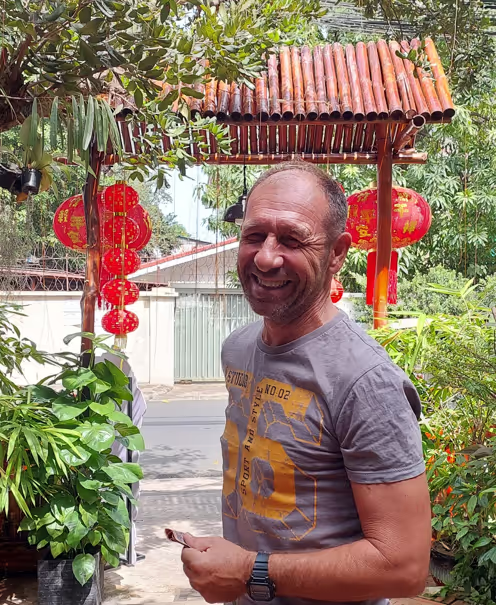
Our home finder in Phnom Penh will help you find your ideal home

Save time and skip the stress

A hand holding a small white house with a red roof and a blue door.
Rent at real local prices

Green shield icon with a white tick: security.
Secure your new home safely from abroad

Why choose a home finder ?

Home finder Bruno (Phnom Penh)

Bruno or another of our home finders will handle your search.

Reliability of listings
Information symbol.
Your home finder is there to select the goods, he visits them, alone, with you in person, or with you by video. And above all, he knows how to rely on reliable business partners who only present him with quality goods.
Icône de fermeture (croix)
Market access
Information symbol.
Your home finder can offer you his own goods, he also has access to all the offers published on the market, and he knows the local agencies and landlords
Icône de fermeture (croix)
Scam risk
Information symbol.
At Remoters, we no longer count the number of French people who have signed a rental contract abroad, without understanding it. Some unscrupulous sellers take advantage of this to insert conditions that are disadvantageous for the tenant. This cannot happen when the contract is reviewed by our home finder.
Icône de fermeture (croix)
Access to local prices
Information symbol.
When you search alone, about 85% of the time goes into searching and 15% into viewings. With a home finder, you only do the viewings
Icône de fermeture (croix)
Application accepted
Information symbol.
In areas where homeowners have plenty of candidates to choose from, they rarely choose foreigners first. Your home finder will use his influence (and his mastery of the language) to put your case before others.
Icône de fermeture (croix)
Information symbol.
Satisfaction
Only 20% of satisfied buyers according to the 2018 Crédit Foncier study. For its part, Remoters gets a score of 4/5 or 5/5 in 95% of cases
Icône de fermeture (croix)

Browsing online listings

Weak
Weak
Elevated
Red cross icon.
Uncertain
20%

Finding with Remoters

Total
Total
Weak
Very likely
95%
Phnom Penh

Finding long-term rental accommodation in Phnom Penh offers genuine opportunities for expats and international professionals, with a wide range of properties available across diverse neighbourhoods — from the vibrant expat hub of BKK1 to the more affordable and family-friendly streets of Toul Kork. However, the market comes with real challenges: fragmented listings, negotiable but opaque pricing, a language barrier in lease contracts, and administrative obligations such as FPCS registration that are easy to overlook. A structured approach — defining your budget in USD/month, researching neighbourhoods thoroughly, verifying lease terms in Khmer, and confirming all administrative requirements — is essential to a successful rental experience. Working with a local rental search specialist significantly reduces the risk of costly mistakes and helps you secure the right property at a fair price.

In short: Phnom Penh offers a wide and accessible long-term rental market for expats, with one-bedroom apartments ranging from around 250 USD/month in emerging areas to 1,000 USD/month or more in premium districts like BKK1. Rents are quoted and paid in USD, utilities are almost always billed separately, and a security deposit of 1 to 2 months' rent is standard. The main challenges are fragmented listings, opaque pricing, Khmer-language lease contracts, and administrative requirements including FPCS registration for foreign tenants. Working with a local rental search specialist helps you navigate these hurdles, negotiate effectively, and move into the right property with confidence.

The Phnom Penh long-term rental market presents several practical challenges for newcomers and expats searching for accommodation independently.

  • Fragmented listings: the rental market is spread across multiple local platforms, Facebook groups, agency websites, and word-of-mouth networks. There is no single centralised listing database, making comprehensive market comparison time-consuming.
  • Inflated asking prices for foreigners: landlords and agents sometimes quote higher rents to foreign tenants unfamiliar with local price benchmarks. Without knowledge of current market rates by neighbourhood, it is easy to overpay.
  • Agent commission fees: many local agents charge fees equivalent to one month's rent or a percentage of the lease value. Agents may also prioritise higher-commission properties over the best-value options for the tenant.
  • Rapid market changes: rental prices and availability in popular districts such as BKK1 and Tonle Bassac can shift quickly, particularly in response to new condo supply or changes in expat demand.
  • Language barrier: while English is widely spoken in expat-facing agencies, direct communication with landlords often requires Khmer, which can complicate negotiations and contract discussions.
  • Variable property quality: listing photos do not always reflect the actual condition of a property. In-person visits and independent verification are essential before committing to a lease.

Renting a property in Phnom Penh as a foreigner involves several administrative steps that can be confusing without local knowledge.

  • FPCS registration: Cambodia's Foreigners' Presence Control System requires landlords to register all foreign tenants with the local commune or sangkat police station. While this is the landlord's legal responsibility, tenants should confirm it is completed to avoid complications at visa renewal time. Failure to register can result in penalties for the landlord.
  • Lease language: rental contracts are typically drafted in Khmer, which is the legally enforceable version. English translations may be provided as a courtesy but are not legally binding. Having the Khmer document reviewed by a trusted local professional before signing is strongly recommended.
  • Visa and residency: long-term renters typically hold an Ordinary (E) visa, which must be renewed regularly. Your rental address is linked to your visa registration, so any change of address requires updating your immigration records.
  • No standardised tenancy law: Cambodia does not have a comprehensive residential tenancy act equivalent to those in Western countries. Tenant protections are limited, and disputes are generally resolved through negotiation or civil courts, making a well-drafted lease essential.
  • Payment in USD: most landlords require rent to be paid in cash or bank transfer in US dollars, which can require setting up a local bank account.

Navigating the Phnom Penh rental market independently can be challenging, particularly for newly arrived expats unfamiliar with local practices, pricing norms, and administrative requirements. A dedicated rental search specialist offers several concrete advantages.

  • Local market expertise: a specialist has up-to-date knowledge of rental prices by neighbourhood, enabling you to identify fair-value properties and avoid overpaying.
  • Local network: many of the best long-term rental options in Phnom Penh are let through local agents and landlords. A well-connected specialist can find properties through local networks and act quickly.
  • Negotiation support: an experienced local intermediary can negotiate rent, deposit terms, and lease conditions on your behalf, often securing better terms than a foreign tenant negotiating directly.
  • Contract and legal guidance: a specialist ensures the lease is reviewed in its Khmer version, that all key clauses are understood, and that FPCS registration obligations are confirmed with the landlord.
  • Time savings: rather than spending weeks visiting unsuitable properties, a specialist pre-selects options that genuinely match your criteria, budget, and lifestyle requirements.
  • Stress reduction: managing the language barrier, coordinating viewings, and handling administrative steps is handled on your behalf, allowing you to focus on your relocation.

A rental search specialist accompanying you in Phnom Penh will carry out a thorough set of checks before recommending any property for a long-term lease. These verifications protect you from common pitfalls in the local rental market and ensure the accommodation genuinely matches your stated needs.

  • Lease contract review: checking that the lease is clear on rent amount, payment schedule, deposit conditions, early termination clauses, and renewal terms. In Cambodia, the legally binding version of a lease is typically in Khmer; a specialist ensures you understand what you are signing.
  • Utility billing structure: confirming whether electricity, water, and internet are included or billed separately, and verifying the applicable rates.
  • FPCS compliance: under Cambodian law, landlords are legally required to register foreign tenants through the Foreigners' Presence Control System (FPCS). A specialist confirms the landlord is willing and able to fulfil this obligation.
  • Property condition: inspecting the state of fixtures, appliances, air conditioning units, plumbing, and common areas before signing.
  • Neighbourhood fit: assessing proximity to your workplace, international schools, healthcare facilities, and daily amenities based on your personal profile.
  • Landlord reliability: gauging the responsiveness and track record of the landlord or property management company for maintenance requests.

A structured rental search process in Phnom Penh typically follows these key steps:

  1. Initial briefing: defining your requirements in detail — budget in USD/month, preferred neighbourhoods, property type (apartment, serviced apartment, villa), number of bedrooms, must-have amenities, proximity to workplace or schools, and desired lease start date.
  2. Market research and shortlisting: the specialist searches across agency databases, local networks, and landlord contacts to compile a shortlist of properties matching your criteria and budget.
  3. Property viewings: accompanied visits to a curated selection of properties, with on-the-spot assessment of condition, neighbourhood, and value for money.
  4. Negotiation: once a preferred property is identified, the specialist negotiates rent, deposit amount, lease duration, and any included services or furnishings directly with the landlord or their agent.
  5. Lease review: the Khmer lease contract is reviewed to ensure all agreed terms are accurately reflected, with particular attention to deposit refund conditions, early termination clauses, and utility billing arrangements.
  6. Signing and move-in: coordinating the signing of the lease, transfer of the security deposit, and handover of keys, including a documented inventory of the property's condition at move-in.
  7. Post-move-in support: confirming FPCS registration with the landlord and assisting with any initial setup steps such as utility connections or local service recommendations.

A rental search service in Phnom Penh is particularly well suited to the following profiles:

  • Newly arrived expats: professionals relocating to Phnom Penh for work who need to find suitable long-term accommodation quickly and without the risk of costly mistakes in an unfamiliar market.
  • International professionals: individuals planning an extended stay of six months or more who want a comfortable, well-located base without committing to a rushed decision.
  • Families with children: households requiring proximity to international schools, safe residential streets, and larger living spaces — typically in districts such as Toul Kork or BKK1.
  • NGO and diplomatic staff: professionals assigned to Phnom Penh on fixed-term contracts who need reliable, well-maintained accommodation close to embassies or international organisations.
  • Retirees and expatriates: individuals planning to live in Phnom Penh long-term who want to understand the market thoroughly before committing to a multi-year lease.
  • Corporate relocations: companies moving employees to Cambodia who require a structured, documented rental search process with full lease verification.

Phnom Penh offers a range of distinct neighbourhoods for long-term renters, each with its own character, price level, and lifestyle profile. Here is a comparative overview of the most popular expat districts:

  • BKK1 (Boeung Keng Kang 1): the most established expat hub, with a dense concentration of cafés, restaurants, embassies, and international services. Rental prices are among the highest in the city, with modern one-bedroom apartments typically ranging from 600 USD/month to 1,000 USD/month. Best suited to professionals and those prioritising convenience and a vibrant social scene.
  • Tonle Bassac: adjacent to BKK1 and close to the central business district, AEON Mall, and major office buildings. A popular choice for business professionals. Rental prices are comparable to BKK1, with a slightly more modern high-rise character.
  • Toul Tom Poung (Russian Market / TTP): a more relaxed, residential neighbourhood popular with younger expats, teachers, and those on mid-range budgets. One-bedroom apartments typically range from 450 USD/month to 650 USD/month. Known for its local market, independent cafés, and walkable streets.
  • Toul Kork: a family-friendly district further north, with more spacious properties and proximity to international schools. Rents are generally more affordable than BKK1, with one-bedroom units from around 400 USD/month and larger family homes available at competitive rates.
  • Daun Penh (Riverside): the historic centre of Phnom Penh, close to the Royal Palace and the Mekong riverfront. Popular with those seeking a more culturally immersive experience. A mix of older buildings and newer serviced apartments.
  • BKK2 and BKK3: more affordable alternatives to BKK1, offering similar central access at lower rental prices. Increasingly popular with budget-conscious expats and younger residents.

Rental budgets in Phnom Penh vary significantly depending on the neighbourhood, property type, and level of furnishing. As a general guide, a studio or entry-level one-bedroom apartment in emerging areas can start from around 250 USD/month, while modern one-bedroom units in popular expat districts such as BKK1 or Tonle Bassac typically range from 450 USD/month to 900 USD/month. Premium serviced apartments in upscale locations can reach 1,000 USD/month or more.

  • Utilities are almost never included in the base rent. Electricity, water, and internet are billed separately and can add 50 USD to 150 USD/month depending on usage and building type.
  • Security deposit: most landlords require the equivalent of 1 to 2 months' rent as a refundable deposit, returned at the end of the lease provided there is no damage and all bills are settled.
  • Lease length affects price: landlords generally prefer a minimum 12-month lease. Shorter-term agreements (under 6 months) are less common and typically priced higher.
  • Negotiation is expected: listed rents are often negotiable, particularly for longer lease commitments. Always compare several listings before agreeing on a price.
  • Currency: rents in Phnom Penh are almost universally quoted and paid in USD. Ensure your budget accounts for this.

Expats searching for long-term rentals in Phnom Penh frequently make avoidable mistakes. Being aware of these pitfalls can save significant time, money, and stress.

  • Signing a lease without reading the Khmer version: the English translation of a lease is not legally binding in Cambodia. Signing without understanding the Khmer document can leave you exposed to unfavourable clauses.
  • Skipping the neighbourhood research phase: choosing an apartment based solely on price or photos without visiting the area at different times of day can lead to disappointment. Traffic, noise levels, flooding risk during the rainy season, and proximity to amenities vary greatly between districts.
  • Not clarifying utility costs upfront: electricity rates in Cambodia can be high, especially in older buildings with less efficient air conditioning. Failing to ask about utility billing before signing can result in unexpectedly high monthly costs.
  • Paying a large deposit without a written contract: some landlords request a deposit to hold a property before a formal lease is signed. Always insist on a written agreement before transferring any funds.
  • Accepting the first price quoted: rents in Phnom Penh are negotiable, especially for longer lease terms. Accepting the initial asking price without negotiating is a common and costly mistake.
  • Ignoring FPCS registration: not confirming that your landlord will complete the mandatory FPCS registration for foreign tenants can create complications with your visa and legal residency status.
  • Visit before you commit: always view a property in person before signing any lease or paying a deposit. Photos and virtual tours rarely capture noise levels, natural light, or the true condition of fixtures.
  • Time your search well: the rental market in popular districts like BKK1 can move quickly. Start your search at least four to six weeks before your intended move-in date to avoid rushed decisions.
  • Negotiate for longer leases: landlords in Phnom Penh are generally more flexible on rent for tenants committing to a 12-month or longer lease. Use this as a negotiating lever.
  • Clarify electricity rates upfront: electricity costs in Cambodia can be significant. Ask the landlord or building management for the per-unit rate before signing, and factor this into your total monthly budget.
  • Insist on a written lease in both Khmer and English: while the Khmer version is legally binding, having an English translation helps you understand your obligations. Have the Khmer version reviewed by a trusted local professional.
  • Confirm FPCS registration: ask your landlord explicitly whether they will register you through the Foreigners' Presence Control System. This is their legal obligation, but confirming it upfront avoids complications with your visa.
  • Explore beyond BKK1: districts such as BKK2, BKK3, and Toul Tom Poung offer comparable convenience at meaningfully lower rental prices. Widening your search area can significantly improve value for money.
  • Document the property condition at move-in: take dated photographs of any existing damage before moving in and share them with your landlord in writing. This protects your deposit at the end of the lease.

Remoters connects expats and international professionals with vetted rental search specialists in Phnom Penh who have hands-on knowledge of the local market. Whether you are relocating for work, planning an extended stay, or moving with your family, Remoters can match you with a local expert who will guide you through every step of your accommodation search — from defining your criteria and shortlisting properties to reviewing your lease and confirming administrative compliance. The service is designed to save you time, protect you from common pitfalls, and ensure you find a rental that genuinely fits your needs and budget in Phnom Penh.

A Home Finder based in Phnom Penh compares the areas popular with expats for you, from BKK1 to Toul Tom Poung or Toul Kork, and sorts through listings scattered across local platforms, Facebook groups, agencies and landlords. They know the benchmark rents, which reduces the risk of overpaying.

They arrange viewings with photos or video, help you negotiate and review the lease before you sign.

You start with a free, no-commitment conversation with a Home Finder in Phnom Penh who speaks English, then receive a quote after describing your budget and areas. It sets out what is included and what happens if the search does not succeed.

The Home Finder shortlists homes, views them with photos or video and supports your application through to signing. You pay online; the funds are released to the Home Finder once the search is complete.

The first pitfall is the Khmer lease, the only legally binding version in Cambodia, since the English translation carries no binding value. The Home Finder has the text reviewed and insists on a written agreement before any money moves.

They also check the electricity rate, the state of the air conditioners, flood risk in the rainy season and the landlord's FPCS registration of foreign tenants.

The landlord must register foreign tenants with the local police post through the FPCS; confirm this before paying, as it avoids complications at visa renewal. Your rental address is tied to your immigration record.

Plan for a deposit of 1 to 2 months' rent, returned at the end of the lease if nothing is damaged. Rents are almost always paid in USD, and a lease of 12 months or more helps you negotiate.

What are you looking for in Phnom Penh?

One of our home finders will look for the ideal property for you

How does it work?

1

First contact:Your home finder offers a free call to understand your needs.

2
Quote: If you’re ready to move forward, you’ll receive a personalized quote via Remoters.
3
Mission start: Once approved and paid, the housing search begins.
4
Support: Your home finder assists you through to the lease signing and your arrival.
5
Feedback: Share your review — your satisfaction is our priority !
A couple lying on a bed, embracing.

We are present around the world!

Remoters continues to grow!
We are recruiting new home finders everywhere, do not hesitate to apply
World map with red markers in the Americas, Europe, Africa and Asia.I am applying

Frequently asked questions

A hand pointing at a laptop screen while the other types.
How does a Home Finder help you rent in the right area of Phnom Penh?

A Home Finder based in Phnom Penh compares the areas popular with expats for you, from BKK1 to Toul Tom Poung or Toul Kork, and sorts through listings scattered across local platforms, Facebook groups, agencies and landlords. They know the benchmark rents, which reduces the risk of overpaying.

They arrange viewings with photos or video, help you negotiate and review the lease before you sign.

A hand pointing at a laptop screen while the other types.
How do you rent in Phnom Penh before you have arrived, step by step?

You start with a free, no-commitment conversation with a Home Finder in Phnom Penh who speaks English, then receive a quote after describing your budget and areas. It sets out what is included and what happens if the search does not succeed.

The Home Finder shortlists homes, views them with photos or video and supports your application through to signing. You pay online; the funds are released to the Home Finder once the search is complete.

A hand pointing at a laptop screen while the other types.
Which pitfalls does a Home Finder rule out for your rental in Phnom Penh?

The first pitfall is the Khmer lease, the only legally binding version in Cambodia, since the English translation carries no binding value. The Home Finder has the text reviewed and insists on a written agreement before any money moves.

They also check the electricity rate, the state of the air conditioners, flood risk in the rainy season and the landlord's FPCS registration of foreign tenants.

A hand pointing at a laptop screen while the other types.
What paperwork and deposit should you plan for to rent in Phnom Penh?

The landlord must register foreign tenants with the local police post through the FPCS; confirm this before paying, as it avoids complications at visa renewal. Your rental address is tied to your immigration record.

Plan for a deposit of 1 to 2 months' rent, returned at the end of the lease if nothing is damaged. Rents are almost always paid in USD, and a lease of 12 months or more helps you negotiate.