
Find a place in Milan within 4 weeks

Emoji de détective avec chapeau, loupe et cheveux gris.
Shortlists properties and visits them for you

Icône de deux mains se serrant avec des flèches bleues au-dessus symbolisant un accord ou partenariat.
Backs your application and negotiates the lease

Icône de bouclier vert avec une coche blanche, symbole de sécurité ou d'assurance.
Every step protected, no hidden surprises

Icône d'une petite bourse rose avec une fermeture dorée.

Personalised support from € 500

You only pay after approving your quote

Why choose a home finder ?

Barbara , ou un autre de nos chasseurs à Milan , prendra en charge votre recherche

Photo chasseur immobilier - Barbara - Milan

Barbara, ou un autre de nos chasseurs à Milan , prendra en charge votre recherche

Reliability of listings
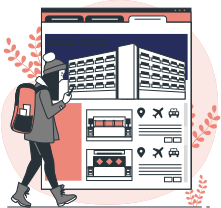
Your hunter is there to select the goods, he visits them, alone, with you in person, or with you by video. And above all, he knows how to rely on reliable business partners who only present him with quality goods.
A pen icon
Market access
Your hunter can offer you his own goods, he also has access to all the offers published on the market, and even to quite a few off market offers
A pen icon
Scam risk
At Remoters, we no longer count the number of French people who have signed a rental contract abroad, without understanding it. Some unscrupulous sellers take advantage of this to insert conditions that are disadvantageous for the tenant. This cannot happen when the contract is reviewed by our hunter.
A pen icon
Access to local prices
Symbole d'information en cercle bleu foncé sur fond transparent.
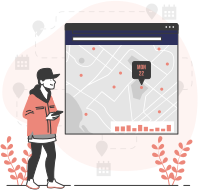
When you search alone, about 85% of the time is spent on research, and 15% on visits. With a hunter, you only do the visits
A pen icon
Application accepted
In areas where homeowners have plenty of candidates to choose from, they rarely choose foreigners first. Your hunter will use his influence (and his mastery of the language) to put your case before others.
A pen icon
Satisfaction
Only 20% of satisfied buyers according to the 2018 Crédit Foncier study. For its part, Remoters gets a score of 4/5 or 5/5 in 95% of cases
A pen icon

Browsing online listings

Weak
Weak
Elevated
Icône rouge de croix X sur fond blanc.
Uncertain
20%

Finding with Remoters

Total
Total
Weak
Very likely
95%
Milan
Milan is Italy's economic and financial capital, home to major institutions such as Bocconi University, Politecnico di Milano, and the Borsa Italiana, making it one of the most sought-after cities for long-term rentals in the country. The rental market is highly competitive, with average monthly rents ranging from approximately 850 EUR/month for a studio in outer districts to over 1,500 EUR/month for a central one-bedroom apartment (source: Investropa / Spotahome, 2025–2026). Key neighborhoods for renters include Brera, Navigli, Porta Nuova, Porta Romana, and Isola in the center, and more affordable options such as Bicocca and Affori-Bovisa further out. Long-term leases in Italy typically follow a 4+4 year structure and must be registered with the Agenzia delle Entrate within 30 days of signing. A Codice Fiscale, proof of income, and a security deposit of 2–3 months' rent are standard requirements for any rental application in Milan.

Milan in brief: Italy's most expensive rental market, with studios from approximately 850 EUR/month and central one-bedrooms exceeding 1,500 EUR/month (source: Investropa / Spotahome, 2025–2026). The standard long-term lease is a 4+4 contract, registered with the Agenzia delle Entrate. You will need a Codice Fiscale, proof of income, and a security deposit of 2–3 months' rent. Top neighborhoods for renters include Brera, Navigli, Porta Nuova, and Porta Romana; more affordable options are found in Bicocca and Affori-Bovisa. Act fast — good apartments go quickly.

Milan is Italy's most cosmopolitan city and its undisputed economic capital, making it a natural destination for professionals, entrepreneurs, students, and international residents seeking a high quality of life in a dynamic urban environment.

  • Economic hub: Milan hosts the headquarters of major Italian and multinational companies, a thriving fashion and design industry, and one of Europe's most active financial centers. It is home to the Borsa Italiana and a dense network of professional services.
  • World-class universities: Institutions such as Bocconi University, Politecnico di Milano, and Università degli Studi di Milano attract tens of thousands of students from around the world each year.
  • Excellent public transport: Milan operates Italy's most extensive urban transport network, managed by ATM (Azienda Trasporti Milanesi). The system includes five metro lines (M1 red, M2 green, M3 yellow, M4 blue, M5 lilac), trams, buses, and suburban rail connections (source: Expat.com, 2024).
  • Culture and lifestyle: From the Pinacoteca di Brera and La Scala opera house to the vibrant Navigli canal district and the annual Salone del Mobile design fair, Milan offers an exceptionally rich cultural and social life.
  • International community: A large and well-established expat community, English-speaking services, and a wide range of international schools make settling in Milan relatively straightforward for newcomers.

Living in Milan day-to-day is efficient, stimulating, and — once you know the ropes — very manageable. Here is what to expect in practical terms:

  • Getting around: Milan's public transport network, operated by ATM, covers the city with five metro lines, trams, and buses. The RicaricaMi rechargeable card replaced paper tickets in 2024 and is used across all ATM services (source: Expat.com, 2024). Most central neighborhoods are also very walkable and cycle-friendly.
  • Administrative setup: After signing your lease, register your residency (residenza) at your local Municipio. This is required for obtaining a health card (tessera sanitaria), registering with a GP, and many other administrative steps.
  • Healthcare: Italy's national health service (Servizio Sanitario Nazionale) is accessible to residents. Register with a local GP (medico di base) after obtaining your residency and health card.
  • Groceries and daily life: Milan has a dense network of supermarkets (Esselunga, Carrefour, Lidl), local markets (mercati rionali), and specialty food shops. The weekly outdoor markets in neighborhoods like Porta Romana and Isola are popular with residents.
  • Language: While English is widely spoken in professional and academic environments, learning basic Italian significantly eases daily interactions with landlords, public offices, and local services.
  • Cost of living beyond rent: A monthly public transport pass costs approximately 39 EUR/month (source: ATM Milano, 2024). Dining out ranges from affordable lunch menus (menu del giorno) at around 10–15 EUR to upscale restaurant dinners. Grocery costs are broadly comparable to other major Western European cities.

Milan's rental market is one of the most dynamic and competitive in Italy. The city serves as Italy's economic and financial capital, attracting a large and diverse population of professionals, students, and international residents, which keeps demand for long-term rentals consistently high.

According to Statista (2024), rental prices in Milan's city center exceed 30 EUR/m²/month, with areas such as Garibaldi, Moscova, and Porta Nuova recording approximately 29.8 EUR/m²/month. Citywide, the average rent per square meter stands at approximately 23 EUR/m²/month (source: Investropa, 2026).

Supply remains tight relative to demand. The combination of a large student population — with institutions such as Bocconi University, Politecnico di Milano, and NABA — alongside a strong expat and corporate community means that well-priced apartments in central and semi-central neighborhoods are typically rented within days of listing. Prospective tenants are advised to act quickly and have all documents ready before beginning their search.

The market has seen sustained upward pressure on rents over recent years, particularly for furnished units and properties close to metro lines. Outer districts such as Bicocca, Affori-Bovisa, and Famagosta-Barona offer more accessible price points while remaining well connected to the city center via the ATM metro network.

Milan is divided into nine administrative municipalities (Municipi), each encompassing several distinct neighborhoods with their own character, rental price range, and lifestyle profile. Here is an overview of the most sought-after areas for long-term renters:

  • Brera: One of Milan's most prestigious and aesthetically refined neighborhoods, known for its art galleries, the Pinacoteca di Brera, and charming cobblestone streets. Rents are among the highest in the city, with rent per square meter exceeding 30 EUR/m²/month. Ideal for those prioritizing safety, beauty, and proximity to the center (source: Investropa, 2026).
  • Navigli: The canal district is lively, social, and popular with young professionals and creatives. It offers a family-friendly atmosphere alongside a vibrant nightlife scene. Rents are slightly more accessible than Brera, at approximately 25 EUR/m²/month (source: Investropa, 2026).
  • Porta Nuova / Garibaldi: A modern, business-oriented district with skyscrapers, multinational offices, and excellent transport links. Popular with young professionals. Rent per square meter is approximately 26–30 EUR/m²/month (source: Investropa / Statista, 2024–2026).
  • Porta Romana: A historic, prestigious, and relatively quiet neighborhood near the center, popular with families and students attending Bocconi University. Offers a good balance of elegance and accessibility (source: HousingAnywhere, 2026).
  • Isola: A trendy, up-and-coming neighborhood with a strong community feel, popular with young professionals seeking a mix of social life and good metro connections (source: HousingAnywhere, 2026).
  • Porta Venezia: Diverse, lively, and well-connected, with a strong café and restaurant culture. A good option for young professionals and first-time renters in Milan.
  • Bicocca / Niguarda: Northern outer districts offering significantly more affordable rents — studios from approximately 700–810 EUR/month — while remaining accessible via metro. Popular with students at Università degli Studi di Milano-Bicocca (source: Investropa, 2026).
  • Affori-Bovisa: One of the most affordable areas in Milan for long-term renters, with studios estimated at around 810 EUR/month. Well served by public transport and increasingly popular with students and young professionals (source: Investropa, 2026).

Renting in Milan requires careful financial planning. The city consistently ranks among the most expensive rental markets in Italy, with central one-bedroom apartments easily exceeding 1,500 EUR/month (source: Spotahome, 2025). For tenants on a tighter budget, outer neighborhoods such as Bicocca, Affori-Bovisa, or Famagosta-Barona offer more accessible rents — studios in these areas can start from around 700–810 EUR/month (source: Investropa, 2026).

When calculating your total monthly housing cost, always factor in condominium charges (spese condominiali), utilities (electricity, gas, internet), and the upfront security deposit of typically 2–3 months' rent. Agency fees, where applicable, are usually equivalent to one month's rent plus 22% VAT (source: Uniplaces, 2024). Setting aside a budget of 3–4 months' rent before your move-in date is strongly recommended to cover all initial costs.

Milan is one of the most expensive rental markets in Italy. According to Investropa's early 2026 data, the average monthly rent for a studio apartment (28–35 m²) is approximately 950 EUR/month, with most units ranging between 850 EUR/month and 1,150 EUR/month depending on location, condition, and furnishing. A one-bedroom apartment (45–55 m²) averages around 1,400 EUR/month. For two- to three-bedroom apartments, families in well-located neighborhoods typically pay between 2,000 EUR/month and 2,800 EUR/month (source: Investropa, 2026).

Furnished apartments command a premium of 10% to 20% over unfurnished units, particularly for studios and one-bedrooms targeting students and expats. In premium central areas such as Centro Storico and Brera, rent per square meter can exceed 33 EUR/m²/month, while outer districts may offer rates as low as 15 EUR/m²/month (source: Investropa, 2026).

Beyond base rent, tenants should budget for condominium charges (spese condominiali), which typically cover building maintenance, heating, and cleaning of common areas. Utility bills (electricity, gas, internet) are generally not included in the rent and add an estimated 100–200 EUR/month depending on the season and apartment size.

Renting a long-term apartment in Milan follows a structured process. Here are the key steps:

  1. Obtain your Codice Fiscale: Before anything else, get Italy's tax identification number from the Agenzia delle Entrate (bring your passport). This is mandatory for signing any lease (source: Immobiliare Santalfredo, 2024).
  2. Define your search criteria: Identify your target neighborhoods, budget (in EUR/month), apartment size, and preferred lease type. Use platforms such as Idealista, Immobiliare.it, or Subito.it, or work with a local agency.
  3. Visit apartments and submit an offer: Once you find a suitable property, the agency or landlord will prepare a formal offer document (proposta di locazione) including your personal details, proposed rent, deposit amount, and contract terms. A cheque or bank transfer equivalent to one month's rent is typically submitted with the offer (source: Languages at Work, 2024).
  4. Prepare your rental dossier: Landlords and agencies require: a valid passport or ID, your Codice Fiscale, proof of income (payslips, employment contract, or bank statements), and — for foreign nationals — a residence permit if applicable (source: Immobiliare Santalfredo, 2024; Phoenix Relocation Group, 2026).
  5. Sign the lease contract: The most common long-term contract is the contratto 4+4 (four years, renewable for four more). A contratto 3+2 transitional lease also exists. Both must be in writing (source: Your Overseas Home, 2025).
  6. Register the contract: The lease must be registered with the Agenzia delle Entrate within 30 days of signing. A registration tax of typically 2% of the annual rent applies, usually split between landlord and tenant (source: Phoenix Relocation Group, 2026).
  7. Pay the security deposit: Typically 2–3 months' rent, paid before or at key handover (source: Languages at Work, 2024).
  8. Register your residency (residenza): Once settled, register at your local Municipio (district office) to obtain official residency, which is required for many administrative procedures in Italy.

Navigating Milan's rental market as a newcomer comes with several common pitfalls. Here are the most frequent mistakes to avoid:

  • Not obtaining a Codice Fiscale before viewing apartments: Italy's tax identification number is mandatory for signing and registering any lease. You can obtain it quickly at the Agenzia delle Entrate with your passport. Arriving at viewings without one signals you are not ready to proceed (source: Phoenix Relocation Group, 2026).
  • Signing an unregistered lease: Italian law requires lease contracts to be registered with the Agenzia delle Entrate within 30 days of signing. An unregistered contract offers you no legal protection as a tenant (source: Phoenix Relocation Group, 2026).
  • Underestimating total move-in costs: Beyond the first month's rent, expect to pay a security deposit of 2–3 months' rent, agency fees (typically one month's rent + 22% VAT), and condominium charges upfront.
  • Ignoring the lease type: The most common long-term contract is the 4+4 (four years, renewable for four more). A 3+2 transitional contract also exists. Confusing these with short-term or tourist rentals can lead to legal complications.
  • Accepting verbal agreements: Always insist on a written, signed, and registered contract. Verbal arrangements have no legal standing in Italy.
  • Not checking condominium charges: Spese condominiali can vary significantly between buildings. Always ask for the last 12 months of charges before committing.
  • Get your Codice Fiscale first: Obtain Italy's tax ID number at the Agenzia delle Entrate before you start viewing apartments. It is mandatory for signing any lease and takes less than an hour with your passport (source: Phoenix Relocation Group, 2026).
  • Prepare a complete rental dossier: Have your passport, Codice Fiscale, last 3 payslips or employment contract, and bank statements ready before your first viewing. Landlords in Milan move fast and expect applicants to be operationally ready.
  • Act quickly: Well-priced apartments in central and semi-central neighborhoods are typically rented within days of listing. If you find a suitable property, be prepared to submit your offer promptly.
  • Verify the lease type: Confirm whether the contract is a 4+4 standard lease or a 3+2 transitional contract, and ensure it is registered with the Agenzia delle Entrate within 30 days of signing (source: Phoenix Relocation Group, 2026).
  • Check condominium charges carefully: Always ask for the last 12 months of spese condominiali before signing. These charges can vary significantly between buildings and are not always included in the advertised rent.
  • Budget for all upfront costs: Plan for a security deposit of 2–3 months' rent, agency fees (typically one month's rent + 22% VAT), and the first month's rent — all due before or at key handover.
  • Consider outer neighborhoods for better value: Areas such as Bicocca, Affori-Bovisa, and Famagosta-Barona offer significantly lower rents than central districts while remaining well connected via the ATM metro network.
  • Use the RicaricaMi card for transport: Since 2024, Milan has phased out paper tickets in favor of the rechargeable RicaricaMi card for all ATM public transport (source: Expat.com, 2024).

Finding a long-term rental in Milan can be a complex and time-consuming process, especially for newcomers unfamiliar with the Italian rental system, local neighborhoods, and administrative requirements. Remoters connects you with vetted local rental search specialists who know the Milan market in depth — from identifying the right neighborhood for your lifestyle and budget to guiding you through the rental dossier, lease negotiation, and contract registration.

Whether you are relocating for work, study, or a lifestyle change, having a dedicated local expert by your side helps you avoid the most common pitfalls — such as missing documents, unregistered contracts, or overlooking hidden costs — and significantly reduces the time it takes to secure a quality apartment in a competitive market.

What are you looking for in Milan?

One of our home finders will look for the ideal property for you

How does it work?

1

First contact:Your home finder offers a free call to understand your needs.

2
Quote: If you’re ready to move forward, you’ll receive a personalized quote via Remoters.
3
Mission start: Once approved and paid, the housing search begins.
4
Support: Your home finder assists you through to the lease signing and your arrival.
5
Feedback: Share your review — your satisfaction is our priority !
Couple allongé sur le lit, pieds contre la tête de lit, s'enlaçant et regardant l'un l'autre.

We are present around the world!

Remoters continues to grow!
We are recruiting new home finders everywhere, do not hesitate to apply
Carte du monde en trois panneaux avec des marqueurs rouges indiquant des emplacements en Amériques, Europe, Afrique et Asie.I am applying